



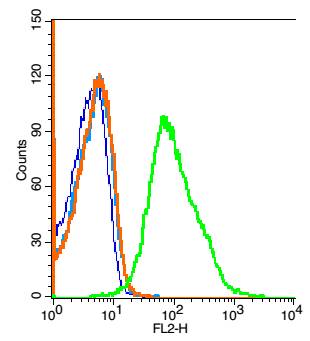
Blank control: Mouse Spleen Cells(fixed with 2% Paraformaldehyde (10 min) , then permeabilized with 90% ice-cold methanol for 30 min on ice).
Primary Antibody:Rabbit Anti- RNF74 antibody(bs-6941R), Dilution: 1ug in 100 uL 1X PBS containing 0.5% BSA;
Isotype Control Antibody: Rabbit IgG(orange) ,used under the same conditions );
Secondary Antibody: Goat anti-rabbit IgG-PE(white blue), Dilution: 1:200 in 1 X PBS containing 0.5% BSA.

- ¥1180 - 2800
- Bioss

- bs-6941R
- 2025年10月16日
- 产品信息以Bioss网站为准

企业认证
相关产品推荐更多 >
万千商家帮你免费找货
0 人在求购买到急需产品
- 详细信息
- 技术资料
- 应用范围:
产品信息以Bioss网站为准
- 规格:
50ul/100ul/200ul
| 规格: | 50ul | 产品价格: | ¥1180.0 |
|---|---|---|---|
| 规格: | 100ul | 产品价格: | ¥1980.0 |
| 规格: | 200ul | 产品价格: | ¥2800.0 |
| 产品编号 | bs-6941R |
| 英文名称 | RNF74 Rabbit pAb |
| 中文名称 | 环指蛋白74抗体 |
| 英文别名 | RAG-1; E3 ubiquitin-protein ligase RAG1; RAG-1; RAG1; RAG1_HUMAN; recombination activating gene 1; recombination activating protein 1; RING finger protein 74; RNF74; V(D)J recombination-activating protein 1. |
| 产品应用 | WB=1:500-2000, Flow-Cyt=1μg/Test Not yet tested in other applications. |
| 交叉反应 | Mouse (Human, Rat, Pig, Sheep) |
| 抗体来源 | Rabbit |
| 免疫原 | KLH conjugated synthetic peptide derived from human RAG1/RNF74 |
| 亚型 | IgG |
| 性状 | Liquid |
| 纯化方法 | affinity purified by Protein A |
| 克隆类型 | Polyclonal |
| 理论分子量 | 115 kDa |
| 浓度 | 1mg/ml |
| 储存液 | 0.01M TBS (pH7.4) with 1% BSA, 0.02% Proclin300 and 50% Glycerol. |
| 研究领域 | Cell Biology > Other Antibodies > Other Antibodies Epigenetics and Nuclear Signaling > DNA / RNA > DNA Damage & Repair > Non Homol. End Joining Immunology > Adaptive Immunity > B Cells > Non-CD Immunology > Adaptive Immunity > T Cells > Non-CD |
| 亚基 | Homodimer. Component of the RAG complex composed of core components RAG1 and RAG2, and associated component HMGB1 or HMGB2. |
| 亚细胞定位 | Nucleus. |
| 组织特异性 | Maturing lymphoid cells. |
| 翻译后修饰 | Autoubiquitinated in the presence of CDC34/UBCH3. |
| 相似性 | Belongs to the RAG1 family. Contains 1 NBD (nonamer binding) DNA-binding domain. Contains 1 RAG1-type zinc finger. Contains 1 RING-type zinc finger. |
| 功能 | Catalytic component of the RAG complex, a multiprotein complex that mediates the DNA cleavage phase during V(D)J recombination. V(D)J recombination assembles a diverse repertoire of immunoglobulin and T-cell receptor genes in developing B and T-lymphocytes through rearrangement of different V (variable), in some cases D (diversity), and J (joining) gene segments. In the RAG complex, RAG1 mediates the DNA-binding to the conserved recombination signal sequences (RSS) and catalyzes the DNA cleavage activities by introducing a double-strand break between the RSS and the adjacent coding segment. RAG2 is not a catalytic component but is required for all known catalytic activities. DNA cleavage occurs in 2 steps: a first nick is introduced in the top strand immediately upstream of the heptamer, generating a 3'-hydroxyl group that can attack the phosphodiester bond on the opposite strand in a direct transesterification reaction, thereby creating 4 DNA ends: 2 hairpin coding ends and 2 blunt, 5'-phosphorylated ends. The chromatin structure plays an essential role in the V(D)J recombination reactions and the presence of histone H3 trimethylated at 'Lys-4' (H3K4me3) stimulates both the nicking and haipinning steps. The RAG complex also plays a role in pre-B cell allelic exclusion, a process leading to expression of a single immunoglobulin heavy chain allele to enforce clonality and monospecific recognition by the B-cell antigen receptor (BCR) expressed on individual B-lymphocytes. The introduction of DNA breaks by the RAG complex on one immunoglobulin allele induces ATM-dependent repositioning of the other allele to pericentromeric heterochromatin, preventing accessibility to the RAG complex and recombination of the second allele. In addition to its endonuclease activity, RAG1 also acts as a E3 ubiquitin-protein ligase that mediates monoubiquitination of histone H3. Histone H3 monoubiquitination is required for the joining step of V(D)J recombination. Mediates polyubiquitination of KPNA1. |
| 保存条件 | Shipped at 4℃. Store at -20℃ for one year. Avoid repeated freeze/thaw cycles. |
| 注意事项 | This product as supplied is intended for research use only, not for use in human, therapeutic or diagnostic applications. |
| 背景资料 | Catalytic component of the RAG complex, a multiprotein complex that mediates the DNA cleavage phase during V(D)J recombination. V(D)J recombination assembles a diverse repertoire of immunoglobulin and T-cell receptor genes in developing B and T lymphocytes through rearrangement of different V (variable), in some cases D (diversity), and J (joining) gene segments. In the RAG complex, RAG1 mediates the DNA-binding to the conserved recombination signal sequences (RSS) and catalyzes the DNA cleavage activities by introducing a double-strand break between the RSS and the adjacent coding segment. RAG2 is not a catalytic component but is required for all known catalytic activities. DNA cleavage occurs in 2 steps: a first nick is introduced in the top strand immediately upstream of the heptamer, generating a 3'-hydroxyl group that can attack the phosphodiester bond on the opposite strand in a direct transesterification reaction, thereby creating 4 DNA ends: 2 hairpin coding ends and 2 blunt, 5'-phosphorylated ends. The chromatin structure plays an essential role in the V(D)J recombination reactions and the presence of histone H3 trimethylated at 'Lys-4' (H3K4me3) stimulates both the nicking and haipinning steps. The RAG complex also plays a role in pre-B cell allelic exclusion, a process leading to expression of a single immunoglobulin heavy chain allele to enforce clonality and monospecific recognition by the B-cell antigen receptor (BCR) expressed on individual B lymphocytes. The introduction of DNA breaks by the RAG complex on one immunoglobulin allele induces ATM-dependent repositioning of the other allele to pericentromeric heterochromatin, preventing accessibility to the RAG complex and recombination of the second allele. In addition to its endonuclease activity, RAG1 also acts as a E3 ubiquitin-protein ligase that mediates monoubiquitination of histone H3. Histone H3 monoubiquitination is required for the joining step of V(D)J recombination. Mediates polyubiquitination of KPNA1. |
| 应用 | 推荐稀释比例 |
| {WB} | {1:500-2000} |
| {Flow-Cyt} | {1μg/Test} |
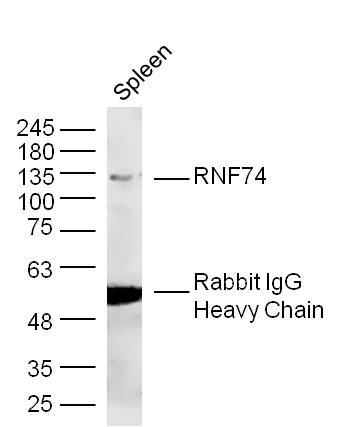
Sample: Spleen (Mouse) Lysate at 40 ug
Primary: Anti-RNF74 (bs-6941R) at 1/300 dilution
Secondary: IRDye800CW Goat Anti-Rabbit IgG at 1/20000 dilution
Predicted band size: 115 kD
Observed band size: 130 kD
Primary: Anti-RNF74 (bs-6941R) at 1/300 dilution
Secondary: IRDye800CW Goat Anti-Rabbit IgG at 1/20000 dilution
Predicted band size: 115 kD
Observed band size: 130 kD
风险提示:丁香通仅作为第三方平台,为商家信息发布提供平台空间。用户咨询产品时请注意保护个人信息及财产安全,合理判断,谨慎选购商品,商家和用户对交易行为负责。对于医疗器械类产品,请先查证核实企业经营资质和医疗器械产品注册证情况。
 技术资料
技术资料暂无技术资料 索取技术资料
RNF74 Rabbit pAb(bs-6941R)-50ul/100ul/200ul
¥1180 - 2800