


- ¥3870
- Agrisera
- 货号AS03 037
- 美国
- 2025年07月14日
- western blot (WB), tissue printing (TP), immunoflu
- 兔
- 植物

企业认证
相关产品推荐更多 >
![DAP3 Mouse Monoclonal Antibody [Clone ID: LBI3H6]](https://img1.dxycdn.com/2022/0707/344/1496323853485278553-14.jpg!wh200)
万千商家帮你免费找货
0 人在求购买到急需产品
- 详细信息
- 文献和实验
- 技术资料
- 抗体名:
兔抗Rubisco大亚基多克隆抗体
- 抗体英文名:
RbcL|Rubisco large subunit,form I and form II
- 浓度:
见说明书
- 应用范围:
western blot (WB), tissue printing (TP), immunoflu
- 宿主:
兔
- 适应物种:
植物
- 标记物:
无
- 克隆性:
多抗/单行
- 保存条件:
低温
- 亚型:
IgG
- 规格:
100 µl
供应商:上海经科化学科技有限公司
服务热线:400-0199-638
QQ:472482400(上海经科)
微信号:shjkchem
活动:消费积分可换充值卡!
兔抗Rubisco大亚基多克隆抗体介绍:
货 号:AS03 037
中文名称:兔抗Rubisco大亚基多克隆抗体
英文名称:RbcL|Rubisco large subunit,form I and form II
应用:western blot (WB), tissue printing (TP), immunoflu
规格:100 µl
价格:3870元
兔抗Rubisco大亚基多克隆抗体简介:
|
|||||||||||||||||||||||||||||||||||||||||
| APPLICATION INFORMATION | ||
| recommended dilution | 1: 5000 - 10 000 with standard ECL (WB), 1: 800 (TP), immunofluorescence/confocal microscopy (IF), 1: 1000 (IG), 1: 250 for images see Prins et al. (2008), detailed protocol available on request |
|
| expected | apparent MW | 52.7 kDa (Arabidopsis thaliana), 52.5 kDa (cyanobacteria), 52.3 (Chlamydomonas reinhardtii) |
|
| confirmed reactivity | Arabidopsis thaliana, Apium graveolens, Artemisia annua, Baculogypsina sphaerulata (benthic foraminifer), Beta vulgaris, Bienertia sinuspersici, Kandelia candel, Cicer arietinum, Chlamydomonas raudensis, Chlamydomonas reinhardtii, Colobanthus quitensis Kunt Bartl, Cyanophora paradoxa, Cylindrospermopsis raciborskii CS-505, Emiliana huxleyi, Euglena gracilis, Fraxinus mandshurica,Fucus vesiculosus, Glycine max, Gonyaulax polyedra, Guzmania hybrid, Heterosigma akashiwo, Hordeum vulgare, Karenia brevis (C.C.Davis) s) G.Hansen & Ø.Moestrup (Wilson isolate), Liquidambar formosana, Malus domestica, Medicago truncatula, Micromonas pusila, Nicotiana benthamiana, Physcomitrella patens, Porphyra sp., Robinia pseudoacacia, Schima superba, Stanleya pinnata, Spinacia oleracea, lichens, Symbiodinium sp., Synechococcus PCC 7942, Rhoeo discolor, Thalassiosira pseudonana, Thermosynechococcus elongatus, Prochlorococcus sp. (surface and deep water ecotype), Triticum aestivum, dinoflagellate endosymbionts (genus Symbiodinium), extreme acidophilic verrucomicrobial methanotroph Methylacidiphilum fumariolicum strain SolV, Thalassiosira punctigera, Tisochrysis lutea, Vitis vinifera |
|
| predicted reactivity | di and monocots, conifers, mosses, liverworts, welwitschia, green algae, red alge, brown algae, cryptomonad, cyanobacteria including prochlorophytes, gamma-proeobacteria, beta-proteobacteria, alpha proteobacteria, Suaeda glauca |
|
| not reactive in | no confirmed exceptions from predicted reactivity known in the moment | |
| additional information | This antibody was used in: Immunocytochemical staining of diatoms according to Schmid (2003) J Phycol 39: 139-153 and Wordemann et al. (1986) J Cell Biol 102: 1688-1698. Immunofluorescence Dreier et al. (2012). FEMS Microbial Ecol., March 2012. Western blot and tissue printing during a student course Ma et al. (2009). |
|
| selected references | Meng et al. (2016). Physiological and proteomic responses to salt stress in chloroplasts of diploid and tetraploid black locust (Robinia pseudoacacia L.). Sci Rep. 2016 Mar 15;6:23098. doi: 10.1038/srep23098 Heinnickel et al. (2016). Tetratricopeptide repeat protein protects photosystem I from oxidative disruption during assembly. Proc Natl Acad Sci U S A. 2016 Mar 8;113(10):2774-9. doi: 10.1073/pnas.1524040113 Young et al. (2015). Antarctic phytoplankton down-regulate their carbon-concentrating mechanisms under high CO2 with no change in growth rates. Marine Ecology Progress Series 532:13-28. Li at al. (2015). Salt stress response of membrane proteome of sugar beet monosomic addition line M14. J Proteomics. 2015 Apr 3. pii: S1874-3919(15)00109-8. doi: 10.1016/j.jprot.2015.03.025. Krasuska et al. (2015). Switch from heterotrophy to autotrophy of apple cotyledons depends on NO signal. Planta. 2015 Jul 18. Janeczko et al. (2015). Disturbances in production of progesterone and their implications in plant studies. Steroids. 2015 Feb 9. pii: S0039-128X(15)00054-9. doi: 10.1016/j.steroids.2015.01.025. Kolesinski et al. (2014). Rubisco Accumulation Factor 1 from Thermosynechococcus elongatus participates in the final stages of ribulose-1,5-bisphosphate carboxylase/oxygenase assembly in Escherichia coli cells and in vitro. FEBS J. 2014 Jul 12. doi: 10.1111/febs.12928 Pandey and Pandey-Rai (2014). Modulations of physiological responses and possible involvement of defense-related secondary metabolites in acclimation of Artemisia annua L. against short-term UV-B radiation. Planta. 2014 Jul 15. Liang et al. (2014). Cyanophycin mediates the accumulation and storage of fixed carbon in non-heterocystous filamentous cyanobacteria from coniform mats. PLoS One. 2014 Feb 7;9(2):e88142. doi: 10.1371/journal.pone.0088142. eCollection 2014. (immunogold) Mayfield et al. (2014). Rubisco Expression in the Dinoflagellate Symbiodinium sp. Is Influenced by Both Photoperiod and Endosymbiotic Lifestyle. Mar Biotechnol, Jan 22. Seveso et al. (2013).Exploring the effect of salinity changes on the levels of Hsp60 in the tropical coralSeriatopora caliendrum. June 29. (Symbiodinium sp. antibody reactivity) Losh et al. (2013). Rubisco is a small fraction of total protein in marine phytoplankton. New Phytol. April 198 (1):52-8. Chen et al. (2013). Photosynthetic and antioxidant responses of Liquidambar formosana and Schima superba seedlings to sulfuric-rich and nitric-rich simulated acid rain. Plant Physiol & Biochem. Li at al. (2012). MAP Kinase 6-mediated activation of vacuolar processing enzyme modulates heat shock-induced programmed cell death in Arabidopsis. New Phytol. ahead of print - RbcL antibody used as loading control. Zhao et al. (2011). Expansins are involved in cell growth mediated by abscisic acid and indole-3-acetic acid under drought stress in wheat. Plant Cell Rep. Nov (RbcL antibody used as a loading control) Johnson (2011). Manipulating RuBisCO accumulation in the green alga, Chlamydomonas reinhardtii. Plant Mol Biol. May 24. Kubien et al. (2011). Quantification of the amount and activity of Rubisco in leaves. Methods Mol Biol.2011;684:349-62. Nicolardi et al. (2011). The adaptive response of lichens to mercury exposure involves changes in photosynthetic machinery. Environmental Pollution (16): 1-10. Zilliges et al (2011) The Cyanobacterial Hepatotoxin Microcystin Binds to Proteins and Increases the Fitness of Microcystis under Oxidative Stress Conditions. PLoS ONE. |
|
application example
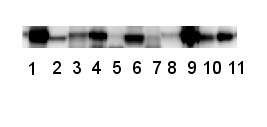
0.25 µg of chlorophyl a/lane from Spinacia oleracea (1), Synechococcus PCC 7942 (2), Cyanophora paradoxa (3), Heterosigma akashiwo (4), Thalassiosira pseudonana (5), Euglena gracilis (6), Micromonas pusilla (7), Chlamydomonas reinhardtii (8), Porphyra sp (9), Gonyaulax polyedra (10), Emiliania huxleyi (11) extracted with PEB (AS08 300), were separated on 4-12% NuPage (Invitrogen) LDS-PAGE and blotted 1h to nitrocellulose. Filters were blocked 1h with 2% low-fat milk powder in TBS-T (0.1% TWEEN 20) and probed with anti-RbcL antibody (AS03 037, 1:50 000, 1h) and secondary anti-rabbit (1:20000, 1 h) antibody (HRP conjugated, recommended secondary antibody AS09 602) in TBS-T containing 2% low fat milk powder. Antibody incubations were followed by washings in TBS-T. All steps were performed at RT with agitation. Blots were developed for 5 min with ECL Advance detection reagent according the manufacturers instructions (GE Healthcare). Images of the blots were obtained using a CCD imager (FluorSMax, Bio-Rad) and Quantity One software (Bio-Rad).
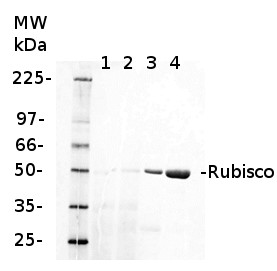
1 µg of chlorophyll from Cryptophyte samples (1,2) and 1 µg of chlorophyll (3) or 10 µg of total protein (4) from Arabidopsis thaliana leaves extracted either with 2ml of 100 mM TrisHCl, 50 mM EDTA, 250 mM NaCl, 0.05% SDS (Sample 1) or 10 mL of 50 mM Hepes-KOH (pH 7.8), 330 mM sorbitol, 10 m EDTA, 5 mM NaCl, 5 mM MgCl2, 5 mM sodium ascorbate and 0.2% BSA (Sample 2). Samples were denatured with 1:1 Amersham WB Loading Bufferv at 70C for 10 min and were separated on pre-casted 13.5% Amersham WB gel and blotted for 30 min to Amersham WB PVDF using wet transfer. Blots were blocked with 2% Amersham ECL Blocking Agent for 1h at room temperature (RT) with agitation. Blot was incubated in the primary antibody at a dilution of 1: 10 000 (rabbit anti-Rubisco AS03 037) for 1.5 h at RT with agitation. The antibody solution was decanted and the blot was rinsed briefly twice, then washed once for 15 min and 3 times for 5 min in TBS-T at RT with agitation. Membrane was cut in half and left part was incubated in anti-rabbit DyLight® 550 secondary antibody (AS11 1782) diluted to 1:2 000 in TBST for 1h at RT with agitation. The blot was scanned using Cy3 channel of Amersham WB System.
Courtesy Dr. Małgorzata Wessels, Agrisera
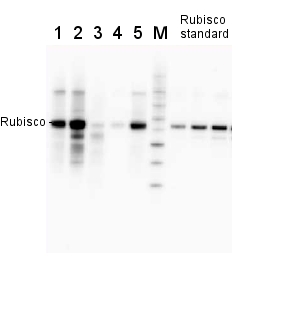
| application example 2 µg of total protein from various plant extracts (1-5) extracted with PEB (AS08 300) separated on 4-12% NuPage (Invitrogen) LDS-PAGE and blotted 1h to PVDF. Markers MagicMarks (Invitrogen) (M) and Rubisco protein standard (AS01 017S) at 0.0625 pmol, 0.125 pmol, 0.25 pmol. Following standard western blot procedure this image has been obtained using a CCD imager (FluorSMax, Bio-Rad) and Quantity One software (Bio-Rad). The contour tool of the software is used to the area for quantitation and the values are background subtracted to give an adjusted volume in counts for each standard and sample.
|
|
风险提示:丁香通仅作为第三方平台,为商家信息发布提供平台空间。用户咨询产品时请注意保护个人信息及财产安全,合理判断,谨慎选购商品,商家和用户对交易行为负责。对于医疗器械类产品,请先查证核实企业经营资质和医疗器械产品注册证情况。
 文献和实验
文献和实验。你的目的蛋白和一抗的关系是什么,这点很重要。分析了这点之后,如果显色时间在1分钟之内,目的带可能是特异带。确信下面的带是特异的,建议换一抗,换其他封闭液。 llh刘丽华 目的蛋白和一抗的关系是什么?我不明白这事什么意思啊,我的目的蛋白RAC1蛋白啊,一抗是兔抗大鼠RAC1多克隆抗体啊! coffeeshine 目的蛋白是在什么宿主细胞里表达的? llh刘丽华 哦,是大鼠平滑肌细胞上表
【公告】丁香通试用中心:10月免费试用装精选(10月18日有更新)
blot显色液 HIV-1P24抗原检测试剂盒 Carrier RNA 免费试用装 兔抗人胱抑素C多克隆抗体 DMEM培养基(高糖) BlotStainer 全自动Blot膜杂交系统 自动原位杂交仪 查看更多试用>> 关注我们 丁香通新浪微博:丁香通 丁香通微信号:biomart
071794 h 货号:CSB-RP071794(A4/C) 兔抗人淀粉样肽 beta A4 蛋白多克隆抗体 货号:CSB-PA07179A0Rb 识别种属:人,小鼠 WB:Mouse heart tissue,Mouse kidney tissue,Mouse lung tissue,293,A549,U251,SH-SY5Y IHC:human kidney
 技术资料
技术资料暂无技术资料 索取技术资料

