

- 询价
- 华拓生物(厂家直销)
- 中国
- HT250094
- 2025年07月13日

企业认证
相关产品推荐更多 >

万千商家帮你免费找货
0 人在求购买到急需产品
相关阅读
香烟烟雾如何加速声带纤维化?CD44-透明质酸轴是关键通路Takara 秋促来袭,提取+反转录+定量套装仅 1200 元abinScience 体内级抗体 全年锁价 低至 ¥1200阿拉丁 22万+ 科研级产品现货速发,品质严控、科研无忧- 详细信息
- 询价记录
- 文献和实验
- 技术资料
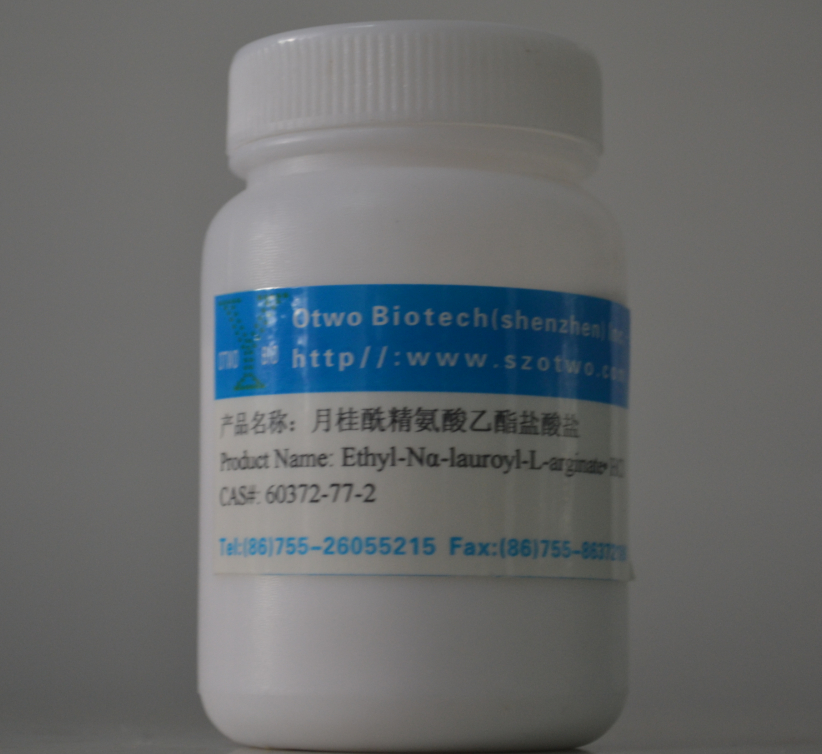
- 英文名:
Ethyl-Nα-lauroyl-L-arginate• HCl
- 库存:
大量
- 供应商:
深圳市豪地华拓生物科技有限公司
- 产品用途:
见说明

1 Introduction
1.1 Description
Chemical Name: Ethyl-Nα-lauroyl-L-arginate• HClSynonyms: EthylLauroyl Arginate HCl, lauramide arginate ethyl ester,
LAE, Lauric arginate
INS No. :243
CAS No.: 60372-77-2
Ethyl-Nα-lauroyl-L-arginate • HCl is an antimicrobial widely used infood and cosmetics industries. It is a cationic surfactant that inhibits theproliferation of a wide variety of microorganisms, including both Gram positiveand Gram negative bacteria,molds and yeasts.
Ithas been evaluated for food safety as antimicrobial in food by the U.S. Foodand Drug Administration (FDA) in 2005 and as a food preservative by theEuropean Food Safety Authority (EFSA) in 2007.
1.2 Applications
Food SectorEthyl-Nα-lauroyl-L-arginate • HCl improvesthe safety of food products,extending their useful life,it can be used in meat products,drinks and juices,cheese,fish products,sauces,ready-made-meals,etc.
Cosmetics Sector
Ethyl-Nα-lauroyl-L-arginate • HCl offershigh antimicrobial activity in applications such as: moisturizing creams,facial soaps, makeup removing milks,toners,deodorants,shampoos,etc. Its INCI name is Ethyllauroyl arginate HCl.
2. Physical and Chemical Properties
2.1 Physical and Chemical Properties of dehydrated LAE
| Test | Result |
| Appearance | White hygroscopic power |
| Molecular weight | 421.02 g/mol |
| Melting temperature | 50.5 to 58.0℃ |
| Boiling temperature | Decomposes from 107℃ |
| Relative density | 1.11 |
| Vapour pressure | 5.45 ×10⁻⁴ Pa at 25℃ |
| Surface tension | 25.43 m N/m for a 1 g/l aqueous solution at 19℃ |
| Water solubility | Greater than 247g/Kg at 20"C |
| Partition coefficient | 1.43 at 20℃ |
| Flammability (solids) | Not highly flammable |
| Explosive properties | Not explosive |
| Relative self-ignition temperature for solids | Does not self ignite |
| Oxidizing properties | Not oxidizing |
| Particle size distribution | 0% below 10µm |
| Soli adsorption coefficient | K∝=58.0 |
2.2 ProductStability
| Stability Test | Results |
| In a closed dark at 25℃ for 10 days and 5,6,10,and 12 months |
No significant degradation was found after 12 months |
| At 30,50,75,100 and 121℃ for 1 and 5 hours | Stable for 5hours at ≤100℃ and for 1 hour at 121℃ |
| At 4,25 and 50℃ and pH 0.5, 1.0, 1.5, 2.0, 2.5, 3.0and 3.5 for 10-52 days | At 4℃, no significant degradation if pH>1.5; at 25℃, no significant degradation if pH>2.5; at 50℃, no significant degradation if pH>3.0 |
| Stability for 1-61 days after application to cooked ham | No significant degradation was found after 61 days at 4℃ |
3. Antimicrobial Efficacy
3.1 Mode of Action
Theactive ingredient,Ethyl-Nα-Iauroyl-L-arginate hydrochloride is a cationicsurfactant that inhibits the proliferation of a wide variety of microorganisms, including both Grampositive and Gram negative bacteria,molds,and yeasts. This inhibitory effect isa direct consequence of its chemical properties as a surface-active compoundthat leads to changes in the conductivity and solubility of solutions.Negatively charged materials, such as bacterial enzymes and membrane proteins, attract cationic surfactants, which degrade orsolubilize cell membranes, leading to loss of membrane potential, altering cell permeability andleaking cellular constituents. These changes result in the arrest of growth orcell lysis.3.2 Ethyl-Nα-Iauroyl-L-arginate· HCl vs Nitrites
Example: LAURIC ARG I NATE AS A PRESERVATIVE FORMARINATED MEATTreatments
Three lots of marinated meat were produced:
The control lot (BI),produced without any preservative.
Treatment with nitrites (NO2). NaNO2 was added at doses of 150 mg/kg of marinated meat. NaNO2was addedas an ingredient more of the marinated solid.
Treatment with Lauric arginate (Ethyl-Nα-Iauroyl-L-arginate•HCl ,LAE).
LAE was added by dipping the fresh beef in a bath at1% of LAE in deionised water during 30 seconds. Fresh beef treated in this waywas used as described in the recipe.
| Days | Sample | BI | NO2 | LAE | Days | Sample | BI | NO2 | LAE |
| 1 | 4.5 | 4.3 | 3.8 | 1 | 7.2 | 6.8 | 4.7 | ||
| 2 | 4.3 | 4.5 | 3.7 | 2 | 7.2 | 7.1 | 5.5 | ||
| 3 | 4.5 | 4.7 | 3.5 | 3 | 7.3 | 6.8 | 5.9 | ||
| 1 | 4 | 4.7 | 4.7 | 3.9 | 14 | 4 | 7.4 | 6.5 | 4.7 |
| 5 | 4.8 | 4.5 | 3.7 | 5 | 7.4 | 6.1 | 3.9 | ||
| X | 4.5 | 4.5 | 3.7 | X | 7.3 | 6.6 | 4.9 | ||
| Α | 0.2 | 0.2 | 0.1 | α | 0.1 | 0.4 | 0.8 | ||
| 1 | 4.5 | 4.3 | 4.0 | 1 | 8.4 | 7.7 | 6.1 | ||
| 2 | 4.9 | 4.8 | 3.9 | 2 | 8.1 | 7.8 | 7.0 | ||
| 3 | 4.7 | 4.2 | 3.7 | 3 | 8.4 | 7.1 | 5.9 | ||
| 3 | 4 | 4.5 | 4.7 | 3.7 | 17 | 4 | 8.4 | 7.3 | 5.9 |
| 5 | 4.5 | 4.3 | 3.8 | 5 | 7.9 | 6.6 | 6.1 | ||
| X | 4.6 | 4.4 | 3.8 | X | 8.2 | 7.3 | 6.2 | ||
| α | 0.2 | 0.3 | 0.1 | α | 0.2 | 0.5 | 0.4 | ||
| 1 | 4.2 | 4.1 | 3.7 | 1 | 8.4 | 8.3 | 5.6 | ||
| 2 | 4.8 | 4.1 | 3.7 | 2 | 8.2 | 8.2 | 7.9 | ||
| 3 | 4.8 | 4.7 | 3.8 | 3 | 8.6 | 7.9 | 5.9 | ||
| 7 | 4 | 4.9 | 4.5 | 3.5 | 21 | 4 | 8.7 | 8.3 | 6.4 |
| 5 | 4.5 | 4.5 | 3.8 | 5 | 8.2 | 7.3 | 7.1 | ||
| X | 4.6 | 4.4 | 3.7 | X | 8.4 | 8.0 | 6.6 | ||
| α | 0.3 | 0.2 | 0.1 | α | 0.2 | 0.4 | 0.9 | ||
| 1 | 6.9 | 4.8 | 3.9 | 1 | 8.5 | 8.7 | 7.7 | ||
| 2 | 6.8 | 4.7 | 4.0 | 2 | 8.7 | 8.6 | 7.4 | ||
| 3 | 6.7 | 4.9 | 3.9 | 3 | 8.5 | 8.3 | 6.9 | ||
| 10 | 4 | 6.9 | 4.7 | 3.9 | 24 | 4 | 8.7 | 8.5 | 7.7 |
| 5 | 6.8 | 4.5 | 4.1 | 5 | 8.1 | 7.9 | 7.2 | ||
| X | 6.8 | 4.7 | 4.0 | X | 8.5 | 8.4 | 7.4 | ||
| α | 0.1 | 0.1 | 0.1 | α | 0.3 | 0.3 | 0.4 |
Microbiologicalresults show that LAE can reduce significantly the growth of natural occurringflora in the marinated meat. According to the previous conclusion,LAE could improve themicrobiological stability of marinated meat and guarantee the maintenance ofall its characteristics once it is consumed.
1. LAE is a good preservative for marinated meat.
2. LAE is a good substitute for nitrites and,nitrates in the preservationof marinated meat.
4 Toxicological Safety and Human Studies
4.1 In Vivo Investigations into the Metabolism of LAE inHumansThisstudy was conducted under Good Laboratory Practice (GLP) standards,as specified in the UK(Statutory Instrument 1999 No.3 106,as amended by Statutory Instrument2004 No. 994), EC (Official Journal No.L 77/8, as amended in OfficialJournal No. L50/44),and OECD (ENV/MC/CHEM(98)17). It was designed to investigate the rate andextent of metabolism of LAE in humans. In the first phase (Centra Labs ClinicalResearch 2005a),two adult males received a single oral dose of 2.5 mg/kg bw LAE as a 25%solution in propylene glycol. Their blood was sampled at 0 h (pre-dose),at 5,10,15,and 30 minutes,and at 1,2,4,8,12,and 24 hours postadministration. The collected plasma was isolated and extracted with methanol;the extract and residue were analyzed by HPLC with limits of quantification of1ng/d for LAE and its major metabolite, LAS, and 20 ng/mL for arginine
Asshown in Figure 1, LAE was not detected at any point and the LAS and argininelevels,declined to non-detectablelevels within 12 hours.
Inthe second phase (Centra Labs Clinical Research 2005b),four adult males wereadministered a single dose of 1.5mg/kg bw LAE as a 25% solution in propyleneglycol. The methods were thesame as in the first study.
Asshown in Figure 2,the result were also similar: LAE was not detected,and the concentrations ofboth LAS and arginine decreased to undetectable levels within 12 hours of administration.

Regulatory Status
A.Center for Food Safety and Applied Nutrition,U.S. Food and Drug Administration(2005) Agency Response Letter GRAS Notice No. GRN 000164,http://cfsan.fda.gov/~rdb/opa-g164.html.B.Scientific Committee on Consumer Products,European Commission (2005) Opinion onEthyl Lauroyl Arginate,COLIPA No P95, SCCP/0837/04.
C.European Food Safety Authority, 2007. Opinion of the Scientific Panel on Food Additives,Flavourings,Processing Aids andMaterials in Contact with Food on a request from the Commission related to anapplication on the use of ethyl lauroyl arginate as a food additive,The EFSA Journal,511,1-27.
D.Food StandardsAustraliaNew Zealand,Application A1015 EthylLauroyl Arginate As A Food Additive Explanatory Statement. This Applicationseeks to amend Standard 1.3.1 Food Additives of the Australia New Zealand FoodStandards Code (the Code) to include a new food preservative,ethyl lauroyl arginate.
5. Application Example
Control of Listeria monocytogenes on Cooked Cured Hamby Formulation with aLactate-Diacetate Blend and Surface Treatment with LAE.
Control ham with no added antimicrobials (control)
Ham formulated with 1.68% potassium lactate and 0.12%sodium diacetate (PLSD)
Control ham with 0.07% LAE as a surface treatment
Ham formulated with PLSD and LAE surface treatment
surface treatment (sprayed in bag and distributedacross meat surface during vacuum packing) (PLSD+ LAE)

Conclusions: Use of a post-Lethality inactivationtreatment such as LAE in combination with a growth inhibitor such as a lactate-diacetate blend in cooked cured ham results in reduction of the pathogen leveland continued suppression of growth when stored under vacuum at refrigeration(4 ℃).
Lauricarginate ethyl ester; lauramide arginine ethyl ester;ethyl-Nα-lauroyl-L-arginate·HCl; LAE; INS No. 243.
Physicochemical characterization
Ethyl lauroyl arginate is a white powder and its solubility in water at 20ºC is greater than247g/kg.Ethyl lauroyl arginate is soluble up to 20% in propyleneglycol, glycerin and ethanol. The pH of 1 % aqueous solution is in the range of3.64 to 4.25.
Chemical characterization
Ethyl-Nα-lauroyl-L-arginate HCl is the active ingredient of ethyl lauroyl arginate and its contents are >85%. Lauric acid, L-arginine HCl and ethanol are materials and their residual amounts are <5.0%, <3% and <0.5%, respectively. Nα-Lauroyl-L-arginine, ethyl laurate and ethyl arginate 2HCl are by-products andtheir contents are <3%, 3%, <1%, respectively. Other three minor by-products share the structure of ethyl-Nα-lauroyl-L-arginate HCl but have an additional lauroyl group. Water contents are <5%. Ashes heated at 700° are mainly NaCl and their amounts are <2%. Arsenic, cadmium, lead and mercury are notdetected.
Functional uses
Ethyl lauroyl arginate is used as preservative. Ethyl-Nα-lauroyl-L-arginate HCl which is a cationic surfactant has a wide spectrum of activity against Gram positive and negative bacteria, yeasts and moulds. It acts on cell membranesand the cytoplasm, and inhibits the growth of populations but in no case is celllysis observed under the conditions studied. It can be used in a wide range of foods.
Reaction and fate infoods
The stability of ethyl-Nα-lauroyl-L-arginate HCl is evaluated in different food matrices. It is found to be stable throughout the duration of the study in allprocessed food matrices.
风险提示:丁香通仅作为第三方平台,为商家信息发布提供平台空间。用户咨询产品时请注意保护个人信息及财产安全,合理判断,谨慎选购商品,商家和用户对交易行为负责。对于医疗器械类产品,请先查证核实企业经营资质和医疗器械产品注册证情况。
 询价记录
询价记录 暂无询价记录
 文献和实验
文献和实验即得氨基酸甲酯盐酸盐。使用使用三乙胺或氮乙基吗啉中和即可。答:1、氨基酸一般在的醇溶液中不溶解,通盐酸气后成氨基酸的盐酸盐,加热后一般溶于醇,氨基酸酯的盐酸盐更易溶于醇,反应是一相的;2、反应一段时间后特别是加热情况下是澄清的,冷却后也可能析出结晶沉淀,不然的话需要除醇后加入如乙醚或乙酸乙酯等溶剂析出结晶;3、通入盐酸气一般至饱和以好。
冲。但没有办法,不过适用于样品量较少的情况。我有很多核磁都是拿板分的。不推荐使用甲醇浸泡,会有硅胶峰,氢谱高场区不好看。我一般是用乙酸乙酯或THF浸泡,室温下振摇1~2小时,沙芯漏斗过滤后旋干即可。 6.我要的是氨基酸甲酯,现在合成了它的盐酸盐,用饱和碳酸氢钠溶液调PH到弱碱性后,无法萃取出来(用过乙醚和乙酸乙酯萃取,大部分还在水里),请教各位大侠如何解决? 答复:你不要用水,不要用碳酸氢钠,而是用有机溶剂加三乙胺调至pH=8-9左右,季铵盐析出,滤掉,剩余你的产品在溶剂中
问:小弟最近用20%盐酸水解某酯类中间体得到如下氨基酸,反应完后用NaOH中和至等电点附近,看到有些灰白色沉淀析出,静置过滤后,滤纸上却只留下了深褐色泥状固体,特别像巧克力化了那种样子,滤液还是呈红棕色,而且这东西(滤饼)在有机溶剂中几乎都不溶,很难重结晶,又来了一次酸溶碱沉还是这样的东西,请问高人如何将这种氨基酸提取出来并纯化?(注:我用滤饼和滤液分别点板,滤饼有三个点,说明肯定有杂质,而滤液反倒只有一个点)谢谢各位。 答:析出来的应该是钠盐吧!你不中和直接做成盐酸盐
 技术资料
技术资料暂无技术资料 索取技术资料

