
- ¥1372
- Invivogen
- ant-mpp
- USA
- 2025年08月11日

企业认证
相关产品推荐更多 >
万千商家帮你免费找货
0 人在求购买到急需产品
- 详细信息
- 询价记录
- 文献和实验
- 技术资料
- 库存:
大量
- 供应商:
研卉生物
- 英文名:
Mycoplasma Removal Agent
- 规格:
25mg
产品优势:1,预防支原体、细菌、真菌污染
2,只需2周即可清除支原体污染
3,不会影响细胞本身代谢
4, 不会重新感染(从其他细胞释放的)支原体
抗微生物污染试剂
Plasmocin™
Mycoplasma Removal Agent
Plasmocin™ is used to cure cell lines infected by mycoplasma and related cell wall-less bacteria.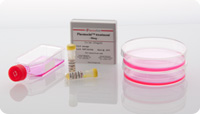 Plasmocin™ can also be used as a routine addition in liquid media to prevent mycoplasma and more generally bacterial contamination in small and large animal cell cultures.
Plasmocin™ is a well-established antimycoplasma reagent. It contains two bactericidal components strongly active against mycoplasmas that allow their elimination in only 2 weeks.
The first component acts on the protein synthesis machinery while the second acts on the DNA replication. These two specific and separate targets are found only in mycoplasmas and many other bacteria and are completely absent in eukaryotic cells.
Warning: InvivoGen's anti-mycoplasma products are suitable for research purposes only, and not for human or animal care.
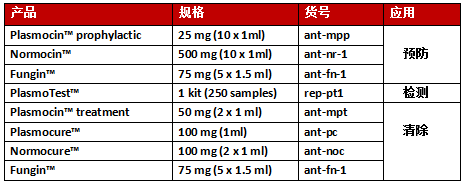
Plasmocin™ prophylactic
2.5 mg/ml (Plasmocin™ Prophylactic)
货号:ant-mpp
支原体预防报价:1372元/25 mg (10 x 1 ml)
Plasmocin™ treatment
货号:ant-mpt25 mg/ml (Plasmocin™Treatment)
支原体清除报价:2114元/50 mg (2 x 1 ml)
Comparison of the most common anti-mycoplasma agents [1-3]
对照表| Product | Supplier | Treatment | Ease of use | Efficacy | Cytotoxicity | Resistance |
|---|---|---|---|---|---|---|
| BM-Cyclin | Roche | 3 weeks | - | +++ | + | +/- |
| Ciprobay | Bayer | 12 to 20 days | + | ++ | +/- | + |
| MRA | ICN | 1 to 2 weeks | + | ++ | +/- | + |
| Plasmocin | InvivoGen | 2 weeks | + | +++ | +/- | - |
Antibiotics commonly used in cell culture are inactive on mycoplasma (e.g. penicillins and streptomycin). Three classes of antibiotics have been shown to kill mycoplasma at relatively low concentrations: tetracyclines, macrolides and quinolones. Tetracyclines and macrolides block the protein synthesis by interfering with ribosome translation, while quinolones inhibit the replication of bacterial DNA.
Several antibiotics are commercially available for the removal of mycoplasma: BM-cyclin (Roche) contains a macrolide and a tetracycline, Ciprobay (Bayer, available only with a prescription) and MRA (ICN) are both quinolones. Plasmocin™ is the only antimycoplasma reagent that combines a macrolide and a quinolone. Unlike BM-Cyclin that requires the sequential and cyclic use of 2 antibiotics, Plasmocin™ is ready-to-use and can be added to the culture medium directly. Furthermore, the 2 antibiotics in Plasmocin™ act on separate targets blocking protein synthesis and DNA replication, whereas the 2 antibiotics in BM-Cyclin are both inhibitors of protein synthesis. Therefore, Plasmocin™ is more effective in removing mycoplasma and prevents the appearance of resistant strains. In contrast to other anti-mycoplasma compounds, Plasmocin™ is active on both free mycoplasma as well as intracellular forms. This advantage is conferred by one component of Plasmocin™ which is actively transported into mammalian cells. It ensures that following treatment with Plasmocin™ a cell culture is not reinfected by mycoplasma released from intracellular compartments of infected cells. To date, no consistent and permanent alterations that affect the eukaryotic cells during and after the treatment have been detected[1].
1. Uphoff CC, Drexler HG., 2005. Eradication of mycoplasma contaminations. Methods Mol Biol. 290:25-34.
2. Somasundaram C. et al., 1992. Use of ciprofloxacin and BM-Cyclin in mycoplasma decontamination.In Vitro Cell Dev Biol. 28A(11-12):708-10
3. Drexler HG. et al., 1994. Treatment of mycoplasma contamination in a large panel of cell cultures. In vitro Cell Dev Biol Anim. 30A(5):344-7
Recent articles using Plasmocin™
- 2012 - J Virol Methods., 187(2):234-7
Mycoplasma removal: Simple curative methods for viral supernatants.
Baronti C, Pastorino B, Charrel R, de Lamballerie X - 2011 - Mol Pharmacol., 80(6):1066-75
Ca2+/calmodulin-dependent kinase (CaMK) signaling via CaMKI and AMP-activated protein kinase contributes to the regulation of WIPI-1 at the onset of autophagy.
Pfisterer SG, Mauthe M, Codogno P, Proikas-Cezanne T - 2011 - J Immunol., 186(12):6822-6829
Tumor cell programmed death ligand 1-mediated T cell suppression is overcome by coexpression of CD80.
Haile ST, Bosch JJ, Agu NI, Zeender AM, Somasundaram P, Srivastava MK, Britting S, Wolf JB, Ksander BR, Ostrand-Rosenberg S - 2012 - J. Biol. Chem., 287: 8082 - 8091
Loss of lysosomal ion channel transient receptor potential channel mucolipin-1 (TRPML1) leads to cathepsin B-dependent apoptosis.
Colletti GA, Miedel MT, Quinn J, Andharia N, Weisz OA, Kiselyov K - 2012 - Immunity, 36(3):464-476
An NLRP7-containing inflammasome mediates recognition of microbial lipopeptides in human macrophages.
Khare S, Dorfleutner A, Bryan NB, Yun C, Radian AD, de Almeida L, Rojanasakul Y, Stehlik C
细胞培养中支原体污染的清除和预防
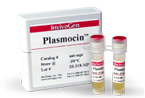 Plasmocin™可以用来消除那些被支原体和某些无细胞壁的细菌感染的细胞系。
在小型或大型细胞培养中,Plasmocin™也可以直接添加到液体培养基中来预防支原体及常见的细菌污染。
Plasmocin™是一种优化的抗支原体试剂。它包含两种抗生素强效作用于支原体,并在两周内迅速杀灭支原体。
其中一种有效成分可以阻断蛋白质合成,另一种则可以作用于DNA复制过程。这两种抗生素作用的特异的靶标仅存在于支原体和很多其它的细菌中,在真核细胞中完全不存在。
Plasmocin™对低浓度的革兰氏阳性菌与革兰氏阴性菌有很好的抗菌性,即便这些菌对于链霉素和青霉素具有抗药性。与市面上的同类产品相比,Plasmocin™对真核细胞的毒性最低。
Plasmocin™已经成功的在不改变细胞状态的情况下,清除支原体污染。包括原代癌细胞[2],培养病毒的细胞[3]和诱导性多能干细胞[4]。
• Plasmocin Prophylactic (2.5 mg/ml):用以预防支原体污染,通常使用浓度2.5 至 5 µg/ml 。
• Plasmocin Treatment (25 mg/ml):用以清除支原体,通常使用浓度 25 µg/ml,处理两个星期。
在T75中,可处理 25 个细胞系。
Plasmocin™为黄色液体,无菌,通过细胞培养检测:
- 25 mg/ml (Plasmocin™Treatment)
- 2.5 mg/ml (Plasmocin™ Prophylactic)
订购
Plasmocin™ prophylactic
内容摘要 预防支原体污染
货号 ant-mpp
单位规格 25 mg (10 x 1 ml)
价格 ¥ 1378
Plasmocin™ treatment
内容摘要 清除支原体污染
货号 ant-mpt
单位规格 50 mg (2 x 1 ml)
价格 ¥ 2119
与其它抗支原体试剂相比,Plasmocin™可同时作用于细胞外与细胞内的支原体。这一优点得益于Plasmocin™其中的一个组份可被转运到哺乳动物细胞内,从而确保Plasmocin™处理后的细胞不会因为细胞释放出来的支原体而再此污染。
目前在所有检测的动物细胞中,即使提高至五倍工作浓度,细胞代谢并没有出现明显变化。
多组独立实验结果显示,按说明书处理后的细胞培养液中不含抗性支原体突变株,证明试剂不会引起支原体抗性株。
Plasmocin™也可作用于低浓度的青霉素,链霉素抗性革兰氏阳性和革兰氏阴性菌。
包括胚胎干细胞,杂交瘤细胞和反转录病毒包装细胞在内的多类细胞的支原体污染,均可被Plasmocin™清除。
抗支原体污染常用试剂比较[1-3]
风险提示:丁香通仅作为第三方平台,为商家信息发布提供平台空间。用户咨询产品时请注意保护个人信息及财产安全,合理判断,谨慎选购商品,商家和用户对交易行为负责。对于医疗器械类产品,请先查证核实企业经营资质和医疗器械产品注册证情况。
- 作者
- 内容
- 询问日期
 文献和实验
文献和实验Chimpanzees, because of their near-human nature, have special needs that must be met by those who carry out medical research with them. Perhaps the most important of these is the need for companionship. Chimpanzees kept alone become obviously
见的污染细胞培养的支原体菌群,但能够污染细胞的支原体种类是很多的,国外调查证明,大约有二十多种支原体能污染细胞,有的细胞株可以同时污染两种以上的支原体。 ??支原体污染的来源包括工作环境的污染、操作者本身的污染(一些支原体在人体是正常菌群)、培养基的污染、污染支原体的细胞造成的交叉污染、实验器材带来的污染和用来制备细胞的原始组织或器官的污染。 ??组织细胞培养工作中,主要从以下几个方面来预防支原体的污染:控制环境污染;严格实验操作;细胞培养基和器材要保证无菌;在细胞培养基中加入适量的抗生素。支原体污染
能污染细胞,有的细胞株可以同时污染两种以上的支原体。 支原体污染的来源包括工作环境的污染、操作者本身的污染(一些支原体在人体是正常菌群)、培养基的污染、污染支原体的细胞造成的交叉污染、实验器材带来的污染和用来制备细胞的原始组织或器官的污染。 组织细胞培养工作中,主要从以下几个方面来预防支原体的污染:控制环境污染;严格实验操作;细胞培养基和器材要保证无菌;在细胞培养基中加入适量的抗生素。支原体污染细胞后,特别是重要的细胞株,有必要清除支原体,常用方法有抗生素处理、抗血清处理、抗生素加抗血清和补体