

- 询价
- BIO-RAD

- MCA5951SBUV795
- 2026年01月23日
- F
- Pig

企业认证
相关产品推荐更多 >
万千商家帮你免费找货
0 人在求购买到急需产品
- 详细信息
- 文献和实验
- 技术资料
- 免疫原:
Porcine PBMCs
- 亚型:
IgG1
- 形态:
Purified IgG conjugated to StarBright UltraViolet 795 - liquid
- 克隆性:
Monoclonal Antibody
- 标记物:
StarBright UltraViolet 795
- 适应物种:
Pig
- 保质期:
自发货之日起 12 个月
- 目录编号:
PPT3
- 供应商:
伯乐生命医学产品(上海)有限公司
- 应用范围:
F
- 浓度:
For information on the concentration of our StarBright Dye conjugated reagents please visit our FAQ page.
- 抗体名:
CD3 antibody | PPT3
- 规格:
100 Tests/0.5ml
小鼠抗猪CD3单克隆抗体(克隆号PPT3) 可识别人源CD3ε的猪同源蛋白。该蛋白是一种由T淋巴细胞表达的24 kDa单次跨膜I型膜蛋白。克隆号PPT3亦被称为FY1H2,在第二届国际猪CD研讨会中被归类,并证实可特异性识别猪CD3ε上的一个表位,该表位被命名为CD3c(Pescovitz, M.D., 等人, 1998)。
CD3是由四条不同多肽链(ε、γ、δ、ζ)组成的多聚体蛋白复合物,它们组装并作为三对二聚体(εγ、εδ、ζζ)行使功能。CD3复合物作为T细胞共受体,与非共价结合的T细胞受体相关联(Guy, C.S & Vignali, D.G. 2009)。CD3是T细胞谱系细胞的一个标志性特征,因此,识别猪CD3的抗体可作为猪T细胞的有效标记物。
研究表明,克隆号PPT3可识别在细胞内和细胞外均有表达的表位。此外,该克隆还被证实能够激活α/β T细胞(Kirkham P.A., 等人, 1996)。
克隆号PPT3已在一系列其他哺乳动物的外周血淋巴细胞上进行测试,结果均为阴性,这表明该克隆识别的表位具有猪种特异性(Yang, H. 等人, 1996)。
| 项目 | 内容 |
|---|---|
| 靶物种 | 猪 |
| 物种交叉反应性 | 靶物种 交叉反应性 牛 ✗ 山羊 ✗ 马 ✗ 人 ✗ 羊 ✗ 注意:抗体反应性和工作条件可能因物种而异。 |
| 免疫原 | 猪外周血单个核细胞 (PBMCs) |
| 近似蛋白浓度 | 关于StarBright染料偶联试剂的浓度信息,请访问我们的FAQ页面。 |
| 产品形式 | 纯化IgG,与StarBright UltraViolet 795偶联 - 液体 |
| 制备方法 | 通过Protein A亲和层析,从组织培养上清液中纯化获得IgG |
| 缓冲溶液 | 磷酸盐缓冲生理盐水 |
| 防腐剂/稳定剂 | 0.09% NaN₃ 1% 牛血清白蛋白 0.1% Pluronic F68 0.1% PEG 3350 0.05% Tween 20 |
| 融合配偶体 | 免疫BALB/c小鼠的淋巴结细胞与NSO骨髓瘤细胞系细胞融合。 |
| 最大激发/发射波长 | 荧光染料:StarBright UltraViolet 795 最大激发波长:340 nm 最大发射波长:792 nm |
| 监管声明 | 仅供研究使用 |
| 保质期 | 自发货之日起12个月 |
| 专利信息 | 本产品受美国专利号10,150,841及相关美国和外国对应专利的保护。 |
储存信息
本产品以环境温度运输。
请在+4°C条件下储存。请勿冷冻。
本产品应原液储存,勿稀释。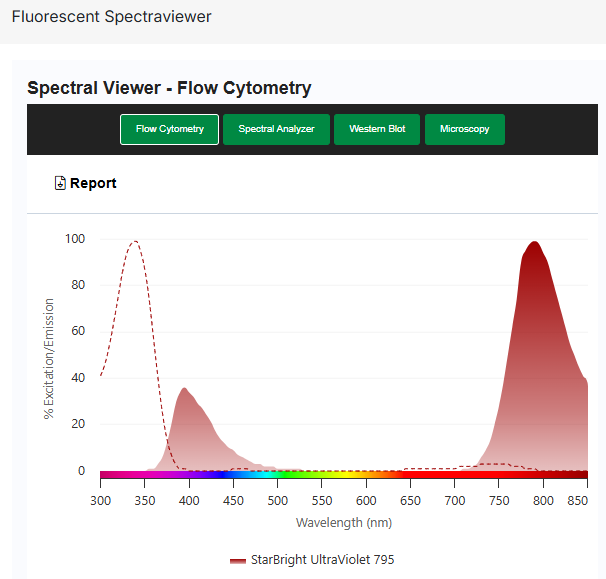
应用
根据我司实验室测试、同行评审出版物或原研者提供的个人通讯,本产品已报道可用于以下应用。详细信息请参阅所引用的参考文献。如需一般实验方案建议,请访问抗体实验方案页面。
| 应用名称 | 已验证 | 推荐最低稀释度 | 推荐最高稀释度 |
|---|---|---|---|
| 流式细胞术 | ✓ | 原液 | - |
若本品未针对某项特定技术进行测试,并不代表其不适用于该技术。推荐的参考工作稀释度仅供参考,建议用户在其体系中通过适当的阴性/阳性对照,自行滴定确定最佳使用浓度。
流式细胞术
建议使用 5 µl 工作稀释液标记 100 µl 体积中的 10⁶ 个细胞。最佳实验流程建议在上样前以 6,000 g 离心 5 分钟。
CD3 is a multimeric protein complex composed of four distinct polypeptide chains (ε, γ, δ, ζ) that assemble and function as three pairs of dimers (εγ, εδ, ζζ). The CD3 complex serves as a T cell co-receptor that associates non-covalently with the T cell receptor (TCR) (Guy, C.S & Vignali, D.G. 2009). CD3 is a defining feature of cells belonging to the T cell lineage, antibodies recognising pig CD3 therefore provide useful markers of porcine T cells.
Clone PPT3 has been demonstrated to recognise an epitope that is expressed both intracellularly and extracellularly, additionally clone PPT3 has been demonstrated to activate α/β T-cells (Kirkham P.A., et al. 1996).
Clone PPT3 was tested on PBL from a range of other mammalian species and found to be negative suggesting that the epitope recognised by this clone is specific to porcine (Yang, H. et al. 1996).
储存信息
Store at +4°C. DO NOT FREEZE.
This product should be stored undiluted.
应用
| Application Name | Verified | Min Dilution | Max Dilution |
|---|---|---|---|
| Flow Cytometry | ✓ | Neat |
Flow Cytometry
Use 5μl of the suggested working dilution to label 106 cells in 100μl. Best practices suggest a 5 minutes centrifugation at 6,000g prior to sample application.
风险提示:丁香通仅作为第三方平台,为商家信息发布提供平台空间。用户咨询产品时请注意保护个人信息及财产安全,合理判断,谨慎选购商品,商家和用户对交易行为负责。对于医疗器械类产品,请先查证核实企业经营资质和医疗器械产品注册证情况。
 文献和实验
文献和实验Source Reference
- Yang, H. et al. (1996) Preparation of monoclonal anti-porcine CD3 antibodies and preliminary characterization of porcine T lymphocytes.
Immunology. 88 (4): 577-85.
References for CD3 antibody
- Kirkham, P.A. et al. (1996) Porcine CD3 epsilon: its characterization, expression and involvement in activation of porcine T lymphocytes.
Immunology. 87 (4): 616-23. - Uehlein, S. et al. (2021) Human-like Response of Pig T Cells to Superagonistic Anti-CD28 Monoclonal Antibodies.
J Immunol. 207 (10): 2473-88. - Zhao, H. et al. (2022) Development of RAG2 -/- IL2Rγ -/Y immune deficient FAH-knockout miniature pig.
Front Immunol. 13: 950194. - Maciag, S.S. et al. (2022) On the influence of the source of porcine colostrum in the development of early immune ontogeny in piglets.
Sci Rep. 12 (1): 15630. - dos Santos, M.C. et al. (2023) Effect of yeast extracted β-glucans on the immune response and reproductive performance of gilts in the adaptation, gestation, and lactation periods
Livestock Science. 275: 105289. - Haach, V. et al. (2023) A polyvalent virosomal influenza vaccine induces broad cellular and humoral immunity in pigs.
Virol J. 20 (1): 181. - Hu, Z. et al. (2019) Genomic variant in porcine TNFRSF1A gene and its effects on TNF signaling pathway in vitro.
Gene. 700: 105-109. - Boschetto, F. et al. (2024) Protocol for extracting and isolating porcine bone-marrow-derived macrophages from ribs.
STAR Protoc. 5 (2): 103085.
Further Reading
- Guy, C.S. & Vignali, D.A. (2009) Organization of proximal signal initiation at the TCR:CD3 complex.
Immunol Rev. 32: 7-21.
无反应状态或死亡。 在体外联合使用 CD3 和 CD28 的抗体刺激 T 细胞,模拟 T 细胞活化的双信号作用,是进行 T 细胞激活与扩增应用最广泛的方法。除直接使用功能学抗体以外,目前磁珠法(CD3/CD28 抗体偶联磁珠)以及多聚体法(CD3/CD28 抗体偶联 Streptamer 多聚体)也是激活扩增 T 细胞比较常见的两种方法。以上说到的无论是抗体法、磁珠法、亦或者是多聚体法,归根结底都是借助于 CD3 与 CD28 抗体对 T 细胞进行刺激。 下面,我们以小鼠脾脏样本为例,分享
流式抗体的选择和配色原则由于在流式细胞实验过程中,荧光抗体对单细胞悬液的标记效果直接影响实验的数据质量。因此,需要考虑各种影响流式抗体品质及检测效果的因素,例如抗体特异性、荧光素信号强弱、荧光素标记方式、同型对照等。本文介绍如何选择合适的流式抗体: 1、需要满足抗体选择的最基本条件:目标蛋白特异性,反应种属以及应用实验等。 靶标特异性:确定标记物名称,确定是细胞表面表达,还是细胞内表达。细胞内表达需要进行透膜。 物种来源:确定待测样本的种属来源。例如,抗小鼠的抗体,不能用于人的样本的检测
基酸序列同源性较高,如果样本的种类未列入抗体说明书上的交叉反应种属表中,并不意味着该抗体不适用于检测该物种的蛋白,而只是表示该物种尚未用此抗体检测验证过,应通过序列比对的方法来预测交叉反应,可应用Expasy 和 NCBI BLAST 来进行不同物种蛋白同源性比对。 四、一抗宿主物种的选择 一般说来,在使用偶联二抗结合无偶联物的一抗时,一抗宿主动物的物种选择较为重要,对于免疫组化而言,尽可能选择与样本不同种系物种的一抗,从而避免二抗与样本内源性免疫球蛋白产生交叉反应,例如:检测小鼠样本蛋白
 技术资料
技术资料暂无技术资料 索取技术资料

