

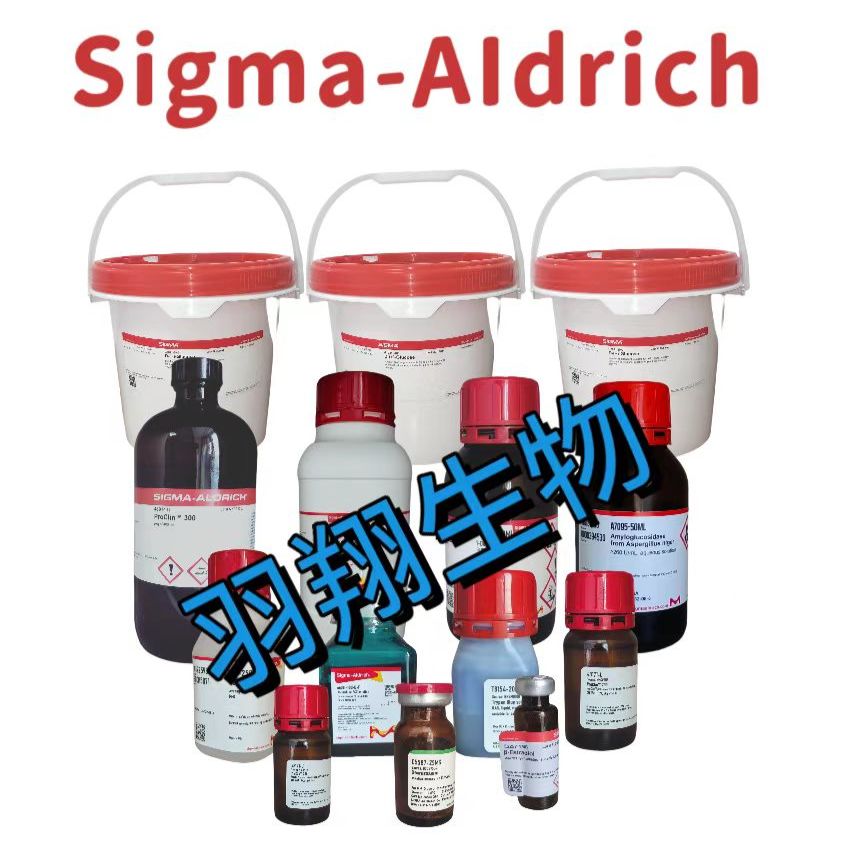
- ¥490
- Sigma-Aldrich
- 进口
- H3375-25G
- 2026年05月29日

企业认证
相关产品推荐更多 >

万千商家帮你免费找货
0 人在求购买到急需产品
相关阅读
香烟烟雾如何加速声带纤维化?CD44-透明质酸轴是关键通路Takara 秋促来袭,提取+反转录+定量套装仅 1200 元abinScience 体内级抗体 全年锁价 低至 ¥1200阿拉丁 22万+ 科研级产品现货速发,品质严控、科研无忧- 详细信息
- 文献和实验
- 技术资料
- 保存条件:
常温
- 保质期:
根据瓶身LOT号查询
- 英文名:
HEPES
- 库存:
有现货
- 供应商:
浙江羽翔生物科技有限公司
- CAS号:
7365-45-9
- 规格:
25G
属性
质量水平
400
方案
≥99.5% (titration)
表单
crystalline powder
储存条件
dry at room temperature
技术
cell culture | mammalian: suitable
颜色
white
pH值(酸碱度)
5.0-6.5 (25 °C, 238 g/L)
有效pH范围
6.8-8.2
pKa (25 °C)
7.5
溶解性
water: 500 mg/mL, clear, colorless
适用性
suitable for component for culture media
suitable for enzyme extraction
应用
diagnostic assay manufacturing
general analytical
life science and biopharma
pharmaceutical
SMILES字符串
OCCN1CCN(CC1)CCS(O)(=O)=O
InChI
1S/C8H18N2O4S/c11-7-5-9-1-3-10(4-2-9)6-8-15(12,13)14/h11H,1-8H2,(H,12,13,14)
InChI key
JKMHFZQWWAIEOD-UHFFFAOYSA-N
一般描述
HEPES 广泛应用于细胞培养,尽管细胞呼吸产生的二氧化碳浓度波动,但 HEPES 在维持生理 pH 值方面表现出色,这一特征在碳酸氢盐缓冲液中并不突出。它可以作为两性分离剂,在等电聚焦中产生 pH 梯度,与含有较少取代胺的缓冲液(如 Tris)相比,它对 DNA-限制性内切酶反应的干扰更小。除了这些应用之外,HEPES 还可以应用于各种生物和生化研究,包括免疫沉淀、细胞裂解和活细胞成像。通用性使其成为各种研究应用中不可或缺的工具。
应用
- 作为Danieau培养基中的一种成分,用于防止斑马鱼胚胎原肠胚形成后的黑色素形成
- 作为Hank溶液中的一个组分用于铁的降解检测
- 作为HEPES培养基中的一个组分用于细胞培养物的质粒转染
- 与RPMI-1640、L-谷氨酰胺、FBS、丙tong酸钠和β-巯基乙醇用于大鼠胰岛瘤细胞的培养
- 作为TCM199培养基中的一种补充剂用于核转移研究所需的新鲜卵母细胞洗涤
特点和优势
- 生化和生物学研究的高纯度产品
- 适用于细胞培养基
- 25°C 时,极易溶于水,pH 值范围为 6.8 - 8.2,pKa 为 7.5
风险提示:丁香通仅作为第三方平台,为商家信息发布提供平台空间。用户咨询产品时请注意保护个人信息及财产安全,合理判断,谨慎选购商品,商家和用户对交易行为负责。对于医疗器械类产品,请先查证核实企业经营资质和医疗器械产品注册证情况。
 文献和实验
文献和实验Five hTRPA1 Agonists Found in Indigenous Korean Mint, Agastache rugosa.
Transient receptor potential ankyrin1 (TRPA1) and transient receptor potential vanilloid 1 (TRPV1) are members of the TRP superfamily of structurally related, nonselective cation channels and mediators of several signaling pathways. Previously, we identified methyl syringate as an hTRPA1 agonist with efficacy against gastric emptying. The aim of this study was to find hTRPA1 and/or hTRPV1 activators in Agastache rugosa (Fisch. et Meyer) O. Kuntze (A.rugosa), commonly known as Korean mint to improve hTRPA1-related phenomena. An extract of the stem and leaves of A.rugosa (Labiatae) selectively activated hTRPA1 and hTRPV1. We next investigated the effects of commercially available compounds found in A.rugosa (acacetin, 4-allylanisole, p-anisaldehyde, apigenin 7-glucoside, L-carveol, β-caryophyllene, trans-p-methoxycinnamaldehyde, methyl eugenol, pachypodol, and rosmarinic acid) on cultured hTRPA1- and hTRPV1-expressing cells. Of the ten compounds, L-carveol, trans-p-methoxycinnamaldehyde, methyl eugenol, 4-allylanisole, and p-anisaldehyde selectively activated hTRPA1, with EC50 values of 189.1±26.8, 29.8±14.9, 160.2±21.9, 1535±315.7, and 546.5±73.0 μM, respectively. The activities of these compounds were effectively inhibited by the hTRPA1 antagonists, ruthenium red and HC-030031. Although the five active compounds showed weaker calcium responses than allyl isothiocyanate (EC50=7.2±1.4 μM), our results suggest that these compounds from the stem and leaves of A.rugosa are specific and selective agonists of hTRPA1.
45Ca2+ uptake study in PC12 cells
, 2mM CaCl2, 10 mM Hepes, pH 7.4) every 15 minutes for 1 hour at 37o C. 3. Add 45Ca2+ (2 µCi/ml) to Ca2+ -free buffer (secretion buffer without 2 mM CaCl2), and drugs to the labelled buffer at 37o C. 4. Incubate the cells with labelled
In Situ HYBRIDIZATION TO TISSUE SECTIONS
. Giemsa (SIGMA GS-500): Use at a 1:20 dilution in 10mM NaHPO4, pH 6.8. 2mg/ml Glycine (SIGMA G7126) in 1X PBS 0.2N HCl 2M HEPES (SIGMA H3375, FW 238.3) Heptane Immersion Oil (Fisher 12-370A, Cargille Type A) Kodak
Dissociated Retina Immunohistochemistry
Solutions 100X trypsin 10 mg/ml in 1X PBS Sigma #T2271 100X soybean trypsin inhibitor 10 mg/ml in 1X PBS Sigma #T6522 1000X DNaseI 2mg/ml in HBSS Sigma #D4513 Explant Culture
 技术资料
技术资料暂无技术资料 索取技术资料

