

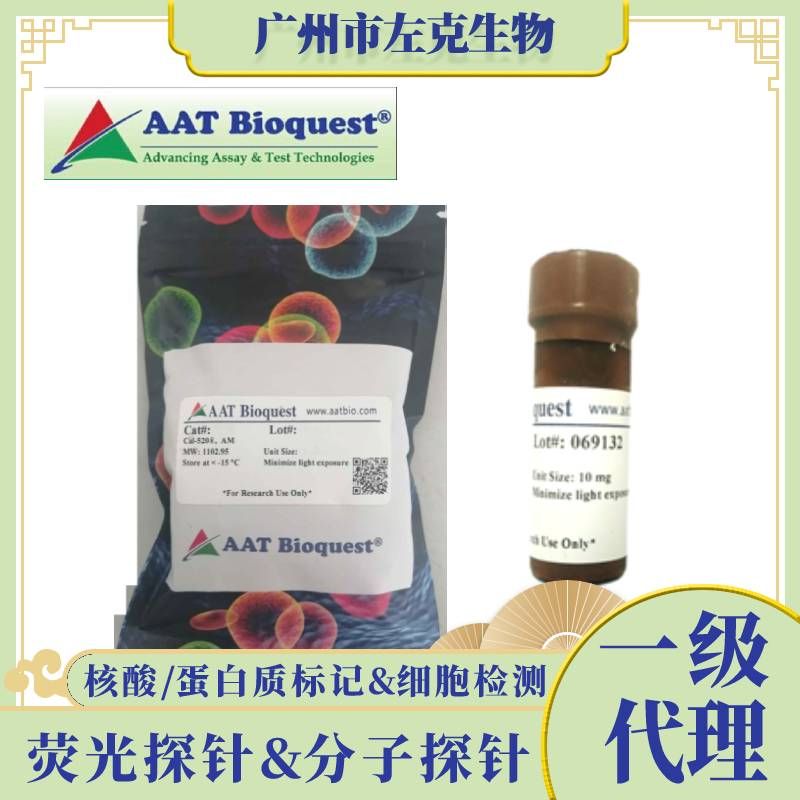
- ¥4104
- AAT Bioquest
- 进口
- 17408
- 2026年04月01日

企业认证
相关产品推荐更多 >
万千商家帮你免费找货
0 人在求购买到急需产品
相关阅读
AJE 润色服务限时 8 折起,权威机构信任 15+ 年Cytoscape 教程来了!快速实现顶刊同款通路网络图五大应用案例:Mustang Q 膜层析应用全解析1 个小工具,一次性搞定流程图、质粒图谱和信号通路图- 详细信息
- 文献和实验
- 技术资料
- 英文名:
ReadiLink™ Cy5 Nick Translation dsDNA Labeling Kit
- 库存:
50
- 供应商:
广州市左克生物科技发展有限公司
- 规格:
10Reactions
| Ex (nm) | 651 | Em (nm) | 670 |
| 分子量 | N/A | 溶剂 | - |
| 存储条件 | - |
ReadiLink Cy5 缺口平移 dsDNA 标记试剂盒提供了一种简单有效的方法,可以使用明亮且光稳定的 Cy5染料标记双链 DNA 样本。标记试剂盒为 DNA 标记所需的完整工作流程提供了所有必要的试剂。该方法使用 DNAse 和 DNA 聚合酶的组合来切割 DNA 螺旋的一条链,Cy5染料与之结合。此外,该试剂盒允许用户通过调整 Cy5-dUTP 偶联物与 dTTP 的比例来优化掺入和产品大小。它与多种样品材料兼容,包括人工染色体 (BAC) DNA、人类基因组 DNA、纯化的 PCR 产物、超螺旋和线性化质粒 DNA。得到的 Cy5标记 DNA 可用于多种分子生物学技术,例如荧光原位杂交 (FISH)。,为您提供优质的ReadiLink Cy5缺口平移 dsDNA 标记试剂盒。
点击查看光谱
样品实验方案
简要概述
- 准备 DNA 样本
- 向试管中加入试剂
- 短暂混合并离心
- 在 15°C 下孵育 60 分钟
- 将反应置于冰上,然后加入停止溶液并在 65°C 下加热
- 使用前在冰上放置 5 分钟或在 4°C 下储存
- 纯化标记的 DNA
注:在开始实验之前,解冻所有成分。在开始标记过程之前,将所有试剂短暂涡旋至底部。
实验步骤
表 1. 各反应每管试剂组成
| 成分 | 规格 |
| DNA样本 | 1 µg DNA 在无核酸酶水中稀释至终体积 34 µL |
| Nick Translation 缓冲液 | 5 µL |
| dNTP 混合物 | 5 µL |
| dTTP | 2 µL |
| Cy5-dUTP 工作溶液 | 2 µL |
| DNA聚合酶I | 1 µL |
| DNA酶I | 1 µL |
| 总容积 | 50 µL |
可以优化孵育时间以获得更好的标记。 更长的孵育时间将有助于更多的标记,但可能会缩短终产品的尺寸。
1.向干净的(无核酸酶)0.5 mL 微型离心管或 0.2 mL PCR 管中,按表 1 中所示的顺序添加试剂。
2.通过短暂的涡旋和短暂的离心小心混合试剂。
3.将反应在 15°C 下孵育 60 分钟。
4.孵育后,将反应置于冰上。
5.要终止反应,请添加 5 µL 停止溶液并将样品加热至 65 °C。
6.使用前在冰上放置 5 分钟或在 4°C 下储存。
7.纯化标记的 DNA。
Assessment of Global DNA Double-Strand End Resection using BrdU-DNA Labeling coupled with Cell Cycle Discrimination Imaging.
Authors: O'Sullivan, Julia and Mersaoui, Sofiane Y and Poirier, Guy and Masson, Jean-Yves
Journal: Journal of visualized experiments : JoVE (2021)
Coupled DNA-labeling and sequencing approach enables the detection of viable-but-non-culturable Vibrio spp. in irrigation water sources in the Chesapeake Bay watershed.
Authors: Malayil, Leena and Chattopadhyay, Suhana and Mongodin, Emmanuel F and Sapkota, Amy R
Journal: Environmental microbiome (2021): 13
Customized optical mapping by CRISPR-Cas9 mediated DNA labeling with multiple sgRNAs.
Authors: Abid, Heba Z and Young, Eleanor and McCaffrey, Jennifer and Raseley, Kaitlin and Varapula, Dharma and Wang, Hung-Yi and Piazza, Danielle and Mell, Joshua and Xiao, Ming
Journal: Nucleic acids research (2021): e8
Fast and Efficient Postsynthetic DNA Labeling in Cells by Means of Strain-Promoted Sydnone-Alkyne Cycloadditions.
Authors: Krell, Katja and Pfeuffer, Bastian and Rönicke, Franziska and Chinoy, Zoeisha S and Favre, Camille and Friscourt, Frédéric and Wagenknecht, Hans-Achim
Journal: Chemistry (Weinheim an der Bergstrasse, Germany) (2021)
Fluorescent SAM analogues for methyltransferase based DNA labeling.
Authors: Goyvaerts, Vince and Van Snick, Sven and D'Huys, Laurens and Vitale, Raffaele and Helmer Lauer, Milena and Wang, Su and Leen, Volker and Dehaen, Wim and Hofkens, Johan
Journal: Chemical communications (Cambridge, England) (2020): 3317-3320
Metabolically-active bacteria in reclaimed water and ponds revealed using bromodeoxyuridine DNA labeling coupled with 16S rRNA and shotgun sequencing.
Authors: Malayil, Leena and Ramachandran, Padmini and Chattopadhyay, Suhana and Cagle, Robin and Hittle, Lauren and Ottesen, Andrea and Mongodin, Emmanuel F and Sapkota, Amy R
Journal: Water research (2020): 116185
Tracing Baculovirus AcMNPV Infection Using a Real-Time Method Based on ANCHORTM DNA Labeling Technology.
Authors: Hinsberger, Aurélie and Graillot, Benoît and Blachère Lopez, Christine and Juliant, Sylvie and Cerutti, Martine and King, Linda A and Possee, Robert D and Gallardo, Franck and Lopez Ferber, Miguel
Journal: Viruses (2020)
Click Chemistry-Based DNA Labeling of Cells for Barcoding Applications.
Authors: Gentile, Stefan D and Griebel, Megan E and Anderson, Erik W and Underhill, Gregory H
Journal: Bioconjugate chemistry (2018): 2846-2854
Multiplexed sgRNA Expression Allows Versatile Single Nonrepetitive DNA Labeling and Endogenous Gene Regulation.
Authors: Shao, Shipeng and Chang, Lei and Sun, Yuao and Hou, Yingping and Fan, Xiaoying and Sun, Yujie
Journal: ACS synthetic biology (2018): 176-186
Real-Time Visualization and Quantification of Human Cytomegalovirus Replication in Living Cells Using the ANCHOR DNA Labeling Technology.
Authors: Mariamé, Bernard and Kappler-Gratias, Sandrine and Kappler, Martin and Balor, Stéphanie and Gallardo, Franck and Bystricky, Kerstin
Journal: Journal of virology (2018)
风险提示:丁香通仅作为第三方平台,为商家信息发布提供平台空间。用户咨询产品时请注意保护个人信息及财产安全,合理判断,谨慎选购商品,商家和用户对交易行为负责。对于医疗器械类产品,请先查证核实企业经营资质和医疗器械产品注册证情况。
 文献和实验
文献和实验直标法因为Cy5标记效率低而导致Cy3、Cy5两种颜色信号强度不同的现象。试剂盒提供除荧光染料外的全部试剂,足够作10次标记。 6)Vysis公司的Microarray Nick Translation Kit 是配合Vysis公司的Genomic Microarray--AmpliOnc I Microarray的荧光标记试剂盒,采用缺口平移的方法将荧光标记的dUTP掺入纯化的样品基因组DNA中作为探针,和AmpliOnc I Microarray进行杂交。 除了厂家为自家的DNA
的Genomic Microarray--AmpliOnc I Microarray的荧光标记试剂盒,采用缺口平移的方法将荧光标记的dUTP掺入纯化的样品基因组DNA中作为探针,和AmpliOnc I Microarray进行杂交。 4.用于多次反复杂交的可洗脱探针制备技术: Ambion公司的Strip-EZ RT Kit是专门为尼龙膜基质的Macroarray,以及各种预制杂交膜而设计的cDNA探针合成标记试剂盒。我们在前面介绍过尼龙膜基质或者塑料基质的Macroarray的优点之一是在杂交检测
后的探针,最后经免疫过氧化物酶的方法来定位杂交探针。这两种方法至今仍有采用,但因敏感度不够高,应用不够普遍。 Pezzella(1987)创建了用磺基化DNA探针来做细胞或组织原位杂交的方法,其基本原理是使DNA探针的胞嘧啶碱基磺基化,利用单克隆 抗体识别磺基化探针,再通过免疫组化方法显示结合的单克隆 抗体,从而对杂交结合的探针进行定位。本法的优点是磺基化DAN探针标记简便,不需作缺口平移标记,敏感度也较高。但自生物素和高辛标记探针技术建立后,已有取而代之的趋势。生物素标记探针技术是Brigat
 技术资料
技术资料暂无技术资料 索取技术资料

