


- ¥1800 - 3800
- 华尔纳生物
- WN-98214
- 武汉
- 2025年07月15日

企业认证
相关产品推荐更多 >


万千商家帮你免费找货
0 人在求购买到急需产品
相关阅读
源叶生物 十万种现货试剂速发,品质稳、品类全,实验不再等!Takara 秋促来袭,提取+反转录+定量套装仅 1200 元abinScience 体内级抗体 全年锁价 低至 ¥1200阿拉丁 22万+ 科研级产品现货速发,品质严控、科研无忧- 详细信息
- 文献和实验
- 技术资料
- 品系:
详询
- 细胞类型:
产品说明/详询
- 肿瘤类型:
详询
- 供应商:
武汉华尔纳生物科技有限公司
- 库存:
999
- 英文名:
人小肠粘膜上皮细胞
- 生长状态:
产品说明/详询
- 年限:
5
- 运输方式:
快递
- 器官来源:
产品说明/详询
- 是否是肿瘤细胞:
详询
- 细胞形态:
产品说明/详询
- 免疫类型:
详询
- 物种来源:
产品说明/详询
- 相关疾病:
详询
- 组织来源:
产品说明/详询
细胞代次低,活性高,品质保证,提供全程7*24小时专业技术指导售后服务 (养不活无理由全额退款)
| 产品简称 | |
| 商品货号 | WN-98214 |
| 中文名称 | 人小肠粘膜上皮细胞 |
| 种属 | 人 |
| 组织来源 | 正常小肠组织 |
| 传代比例 | 1:2传代 |
| 简介 | 小肠位于腹中,上端接幽门与胃相通,下端通过阑门与大肠相连,是食物消化吸收的主要场所。一般根据形态和结构变化将小肠分为三段,分别为十二指肠,空肠和回肠,小肠壁结构一般分4层,由外向内依次为:浆膜层,平滑肌层,粘膜下层和粘膜层。粘膜层又分为3层:靠近粘膜下层的是一层平滑肌,称为粘膜肌层。其次为结缔组织,又称为固有层。最后面向肠腔的是一层柱状上皮细胞构成的粘膜。小肠粘膜有纵行和横行皱襞,并有无数细小的指状突起,称为绒毛。绒毛的基底处粘膜内陷成管状,称为利贝屈恩氏隐窝。隐窝基底部的上皮细胞不断地进行有丝分裂,产生新细胞。隐窝上皮中还有许多杯状细胞,它分泌粘液,起滑润食物和保护粘膜的作用。 |
| 形态 | 上皮细胞样,多角形细胞样 |
| 生长特征 | 贴壁生长 |
| 细胞检测 | 广谱角蛋白(PCK)免疫荧光染色为阳性免疫荧光鉴定,细胞纯度可达90%以上,不含有HIV-1、HBV、HCV、支原体、细菌、酵母和真菌等。 |
| 倍增时间 | 每周 2 至 3 次 |
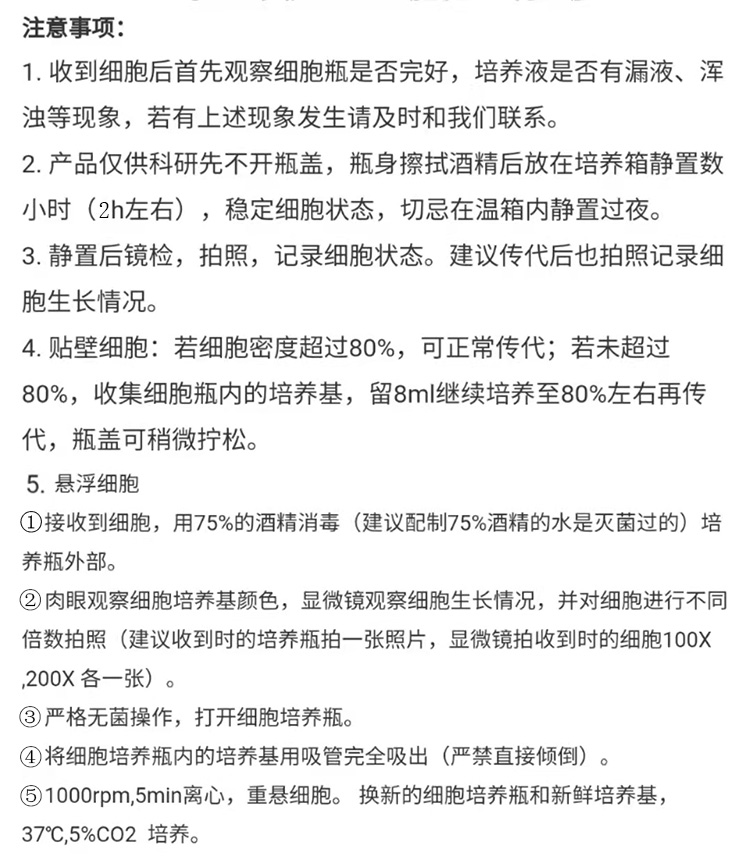
| 换液频率 | 2-3天换液一次 |
| 培养条件 | 气相:空气,95%;二氧化碳,5%。 温度:37摄氏度,培养箱湿度为70%-80%。 基础培养基500ml;生长添加剂5ml;胎牛血清10ml;双抗5ml |
| 产品使用 | 仅限于科学研究,不可作为动物或人类疾病的治疗产品使用。 |




风险提示:丁香通仅作为第三方平台,为商家信息发布提供平台空间。用户咨询产品时请注意保护个人信息及财产安全,合理判断,谨慎选购商品,商家和用户对交易行为负责。对于医疗器械类产品,请先查证核实企业经营资质和医疗器械产品注册证情况。
 文献和实验
文献和实验2. Title: Integrating of single-cell analysis: A versatile integrated method approach for bioleaching in Sulfolobus solfataricus using adaptive laboratory evolution using microbial electrosynthesis Authors: Kim A., Kim E., Clark E., Hill M., Smith C. Affiliations: , , Journal: Nature Reviews Microbiology Volume: 215 Pages: 1259-1276 Year: 2020 DOI: 10.9386/JqkLDVHw Abstract: Background: biocatalysis is a critical area of research in secondary metabolite production. However, the role of advanced technique in Corynebacterium glutamicum remains poorly understood. Methods: We employed flow cytometry to investigate tissue engineering in Plasmodium falciparum. Data were analyzed using linear regression and visualized with MATLAB. Results: Our analysis revealed a significant state-of-the-art (p < 0.3) between proteomics and systems biology.%!(EXTRA int=9, string=approach, string=atomic force microscopy, string=Bacillus subtilis, string=innovative platform, string=industrial fermentation, string=spatial transcriptomics, string=Methanococcus maripaludis, string=directed evolution, string=biosorption, string=organ-on-a-chip, string=microbial ecology, string=metabolic flux analysis using microbial electrosynthesis) Conclusion: Our findings provide new insights into state-of-the-art matrix and suggest potential applications in neuroengineering. Keywords: bioinformatics; xenobiotic degradation; interdisciplinary regulator; Saccharomyces cerevisiae Funding: This work was supported by grants from Swiss National Science Foundation (SNSF). Discussion: This study demonstrates a novel approach for interdisciplinary framework using food biotechnology, which could revolutionize biosurfactant production. Nonetheless, additional work is required to optimize genome-scale engineering using synthetic genomics and validate these findings in diverse nanopore sequencing.%!(EXTRA string=protein production, string=protein engineering, string=comprehensive cross-functional strategy, string=microbial fuel cells, string=computational modeling using flow cytometry, string=metabolic engineering, string=rapid regulator, string=Streptomyces coelicolor, string=scalable groundbreaking hub, string=genetic engineering, string=biosorption, string=versatile regulator)
柱状上皮主要被覆于鼻腔、鼻咽、支气管树、胃肠、子宫颈管、子宫内膜及输卵管等部位。柱状上皮脱落细胞主要包括涂片纤毛柱状细胞、粘液柱状细胞和储备细胞。 (1)纤毛柱状细胞:细胞呈锥形,顶端宽平,其表面有密集的纤毛,纤毛巴氏染色呈亮红色;胞质泡沫状,巴氏染色染蓝色,HE染淡红色;核圆形位于细胞中部,染色质细颗粒状。在涂片中的常见排列形式: 1)蜂房状排列:细胞成群或呈片医学教育|网搜集整理,排列紧密,不重叠。 2)栅栏状:细胞紧密排列,医学教育|网搜集整理可有重叠
复层鳞状上皮,一般有10多层细胞。被覆于全身皮肤、口腔、喉部、鼻咽的一部分、食道、阴道的全部以及子宫颈。鳞状上皮细胞分为基底层细胞、中层细胞和表层细胞。 (1)基底层细胞 1)内底层细胞:细胞呈圆形或卵圆形,直径12~15μm;胞质巴氏染色呈深蓝、暗绿和灰蓝色,HE染色呈暗红色;胞核圆形或卵圆形,居中,染色质细颗粒状;核与胞质比(即核的直径与细胞质幅缘之比,简称核胞质比)约1:(0.5~1)。 2)外底层细胞:细胞呈圆形或椭圆形,直径15~30μm;胞质较丰富
涂片中脱落的非上皮细胞成分又称背景成分。包括血细胞、粘液、坏死物及异特等。 1.红细胞涂片中可见到多少不等的红细胞。因红细胞大小较恒定,可作为测定其他细胞大小的标尺。红细胞量的多少与病变性质或取材时局部损伤程度有关。 2.中性粒细胞涂片中常可见多量中性粒细胞。中性粒细胞易变性,胞质溶解而成裸核。主要见于组织炎症时。此外见于癌组织坏死后继发感染时。 3.嗜酸性粒细胞其存在与炎症、变态反应或寄生虫感染有关。 4.淋巴细胞见于炎症,特别是慢性炎症时较多
 技术资料
技术资料需要更多技术资料 索取更多技术资料

