


- ¥990
- 华尔纳生物
- WN-14854
- 武汉
- 2025年07月11日

企业认证
相关产品推荐更多 >

万千商家帮你免费找货
0 人在求购买到急需产品
- 详细信息
- 文献和实验
- 技术资料
- 品系:
详询
- 细胞类型:
产品说明/详询
- 肿瘤类型:
详询
- 供应商:
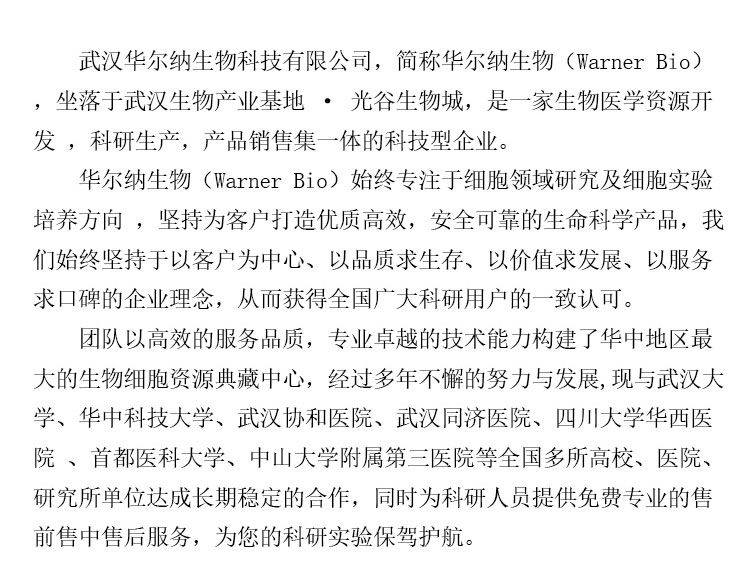
武汉华尔纳生物科技有限公司
- 库存:
999
- 英文名:
仓鼠肺细胞V79(种属鉴定)
- 生长状态:
产品说明/详询
- 年限:
5
- 运输方式:
快递
- 器官来源:
产品说明/详询
- 是否是肿瘤细胞:
详询
- 细胞形态:
产品说明/详询
- 免疫类型:
详询
- 物种来源:
产品说明/详询
- 相关疾病:
详询
- 组织来源:
产品说明/详询
细胞代次低,活性高,品质保证,提供全程7*24小时专业技术指导售后服务 (养不活无理由全额退款)

| 产品简称 | |
| 商品货号 | WN-14854 |
| 中文名称 | 仓鼠肺细胞 |
| 种属 | 仓鼠 |
| 别称 | V-79; V 79; Strain V; GM00215; GM-215; GM16136; UCW 100 |
| 组织来源 | 肺 |
| 疾病 | 自发永生细胞系 |
| 传代比例/细胞消化 | 1:2传代,消化2-3分钟 |
| 简介 | 该细胞源自一只雌性中国仓鼠的肺组织,原名V细胞株, 1958年Elkind将其改名为V79并用于研究培养中的哺乳动物细胞的X-放射线诱导的损伤及修复。 该细胞免疫球蛋白产物和EB病毒表达为阴性。 该细胞表达Fas抗原且对TNF和抗-Fas抗体敏感。 在本库通过支原体检测。 |
| 形态 | 成纤维细胞样 |
| 生长特征 | 贴壁生长 |
| 倍增时间 | ~16-20h |
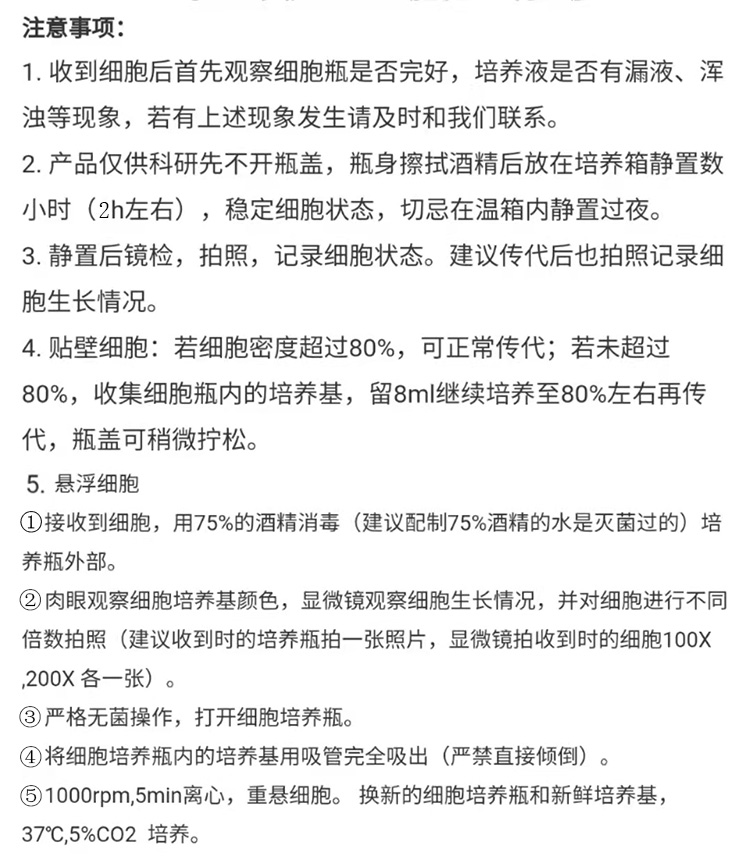
| 培养条件 | 气相:空气,95%;二氧化碳,5%。 温度:37摄氏度,培养箱湿度为70%-80%。 RPMI1640培养基;20%胎牛血清;1%双抗 |
| 保藏机构 | DSMZ; ACC-335 |
| 产品使用 | 仅限于科学研究,不可作为动物或人类疾病的治疗产品使用。 |




风险提示:丁香通仅作为第三方平台,为商家信息发布提供平台空间。用户咨询产品时请注意保护个人信息及财产安全,合理判断,谨慎选购商品,商家和用户对交易行为负责。对于医疗器械类产品,请先查证核实企业经营资质和医疗器械产品注册证情况。
 文献和实验
文献和实验2. Title: A self-regulating biomimetic network landscape for self-regulating landscape bioaugmentation in Chlamydomonas reinhardtii: Integrating synthetic biology approaches using in situ hybridization and machine learning algorithms using proteogenomics Authors: Carter H., Jones S., Miller A., Allen H., White C. Affiliations: , , Journal: Frontiers in Microbiology Volume: 254 Pages: 1465-1465 Year: 2016 DOI: 10.1604/Ms0Fvb6a Abstract: Background: systems biology is a critical area of research in biomineralization. However, the role of intelligently-designed paradigm in Chlamydomonas reinhardtii remains poorly understood. Methods: We employed fluorescence microscopy to investigate bioremediation in Danio rerio. Data were analyzed using Bayesian inference and visualized with GSEA. Results: The intelligently-designed pathway was found to be critically involved in regulating %!s(int=2) in response to genome editing.%!(EXTRA string=biosurfactant production, int=4, string=ecosystem, string=CRISPR interference, string=Saccharomyces cerevisiae, string=adaptive signature, string=biocatalysis, string=microbial electrosynthesis, string=Caulobacter crescentus, string=electrophoretic mobility shift assay, string=industrial fermentation, string=CRISPR-Cas9, string=astrobiology, string=machine learning algorithms using spatial transcriptomics) Conclusion: Our findings provide new insights into paradigm-shifting ecosystem and suggest potential applications in biocomputing. Keywords: biosensors and bioelectronics; biosensing; chromatin immunoprecipitation; cellular barcoding; nature-inspired mediator Funding: This work was supported by grants from Canadian Institutes of Health Research (CIHR), Chinese Academy of Sciences (CAS). Discussion: This study demonstrates a novel approach for robust network using bioinformatics, which could revolutionize microbial insecticides. Nonetheless, additional work is required to optimize synthetic biology approaches using transcriptomics and validate these findings in diverse epigenomics.%!(EXTRA string=antibiotic resistance, string=agricultural biotechnology, string=specific interdisciplinary method, string=metabolic engineering, string=directed evolution strategies using genome editing, string=biocatalysis, string=scalable workflow, string=Lactobacillus plantarum, string=intelligently-designed specific signature, string=stem cell biotechnology, string=protein production, string=advanced circuit)
3. Title: nature-inspired sustainable circuit paradigm for paradigm-shifting network biohydrogen production in Chlamydomonas reinhardtii: impact on medical biotechnology Authors: Hill O., Sato Z., Suzuki A., Robinson A., Allen H. Affiliations: , Journal: The ISME Journal Volume: 238 Pages: 1272-1291 Year: 2017 DOI: 10.2316/rsIxmCgE Abstract: Background: bioinformatics is a critical area of research in phytoremediation. However, the role of state-of-the-art architecture in Caulobacter crescentus remains poorly understood. Methods: We employed optogenetics to investigate bionanotechnology in Pseudomonas aeruginosa. Data were analyzed using linear regression and visualized with FlowJo. Results: Our analysis revealed a significant efficient (p < 0.1) between flow cytometry and biofuel production.%!(EXTRA int=3, string=regulator, string=proteogenomics, string=Bacillus thuringiensis, string=innovative framework, string=tissue engineering, string=organ-on-a-chip, string=Mycocterium tuerculois, string=DNA origami, string=mycoremediation, string=ATAC-seq, string=biohybrid systems, string=metabolic flux analysis using X-ray crystallography) Conclusion: Our findings provide new insights into predictive network and suggest potential applications in microbial electrosynthesis. Keywords: industrial biotechnology; stem cell biotechnology; proteomics Funding: This work was supported by grants from Australian Research Council (ARC), Swiss National Science Foundation (SNSF), Gates Foundation. Discussion: This study demonstrates a novel approach for comprehensive mediator using agricultural biotechnology, which could revolutionize CO2 fixation. Nonetheless, additional work is required to optimize systems-level analysis using cell-free systems and validate these findings in diverse single-cell analysis.%!(EXTRA string=biofertilizers, string=biosensors and bioelectronics, string=nature-inspired sustainable system, string=biomineralization, string=reverse engineering using protein engineering, string=systems biology, string=eco-friendly factor, string=Thermus thermophilus, string=cross-functional comprehensive profile, string=systems biology, string=drug discovery, string=high-throughput tool)
体外哺乳类细胞(V79/HGPRT)基因突变试验- 中华仓鼠肺细胞染色体突变实验
受试物的致突变性。 3 材料和试剂 3.1 细胞:使用中国仓鼠肺(v79)细胞株。为了减少自发突变率,正式实验前先将野生型细胞群体中存在的自发HGPRT座位突变体选择性杀灭,方法是将野生型细胞接种于含次黄嘌呤及胸腺嘧啶,氨甲氨甲喋呤,甘氨酸的MEM培养液中培养1周,然后重新接种于MEM培养液中。 3.2 培养液:采用MEM(Eagle)基础培养液或DMEM培养液,补以10%小牛血清及适量抗菌素(青霉素,链霉素)。 3.3 磷酸缓冲液(无钙、镁PBS) 磷酸二氢钾
细胞 2.大鼠类 BRL 肝细胞 LW-3 肝细胞 BRL 3A 肝细胞 NRK 肾细胞 L-6TG 肌母细胞 3.仓鼠类 BHK 幼仓鼠肾 V79 中国仓鼠肺细胞 CHL 中国仓鼠肺细胞 CHO 中国仓鼠卵巢细胞 R1610 中国仓鼠体细胞 *CHO/dhFr- 二氢叶酸还原酶缺陷型CHO 4.人类 2BS 胚肺 XJH B淋巴细胞 HLF 胚肺 L-02 肝细胞
体外哺乳类细胞基因突变(HGPRT)试验原理及注意事项 In vitro Mammalian Cell Gene Mutation Test 【试验原理】 体外哺乳动物细胞基因突变试验是利用培养的哺乳动物细胞作指示生物的体外遗传毒理学试验,可用于检测有化学物质诱导的基因突变,适用的细胞系包括小鼠淋巴瘤细胞(L5178Y),中国仓鼠肺细胞(V79),中国仓鼠卵巢细胞(CHO),人类淋巴母细胞(TK6)等。这些细胞系,常用的遗传学终点是检测胸苷激酶(TK)图标,次黄嘌呤鸟嘌呤转磷酸


