

- ¥600 - 3200
- 上海莼试
- CS-01Y75225
- 国产
- 2025年07月31日
9 年钻石会员
企业认证
相关产品推荐更多 >
万千商家帮你免费找货
0 人在求购买到急需产品
- 详细信息
- 文献和实验
- 技术资料
- 库存:
31
- 英文名:
TRAM-34
- CAS号:
289905-88-0
- 供应商:
上海莼试
- 保存条件:
Store at -20°C
- 规格:
5mg 25mg 100mg
本产品仅供科学实验研究使用! 不能用于临床或动物诊断!
化学性质:

TRAM-34规格:5mg 25mg 100mg
CAS:289905-88-0
别名:
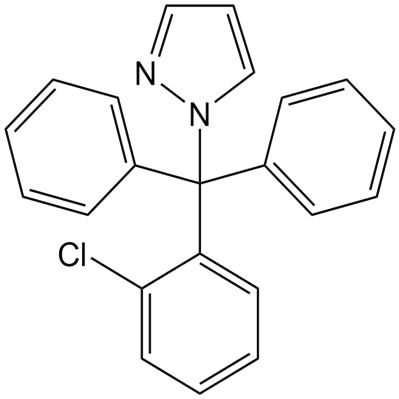
化学名:1-[(2-chlorophenyl)-diphenylmethyl]pyrazole
分子式:C22H17ClN2
分子量:344.84
溶解度:≥ 17.25mg/mL in DMSO
储存条件:Store at -20°C
General tips:For obtaining a higher solubility , please warm the tube at 37 ℃ and shake it in the ultrasonic bath for a while.
Shipping Condition: Evaluation sample solution : ship with blue ice All other available size: ship with RT , or blue ice upon request
产品描述:
TRAM-34 is a highly selective inhibitor of KCa3.1 channel with IC50 value of 20 nM [1].The Ca (2+)-binding protein calmodulin (CaM) confers Ca (2+) sensitivity to KCa3.1 of KCa3.1. On the basis of crystal structure obtained for the C-terminal region of the rat KCa2.2 channel (rSK2) with CaM that the binding of Ca (2+) to the CaM N-lobe results in CaM interlocking the C-terminal regions of two adjacent KCa3.1 subunits, leading to the formation of a dimeric structure. It is reported that many factors can increase KCa3.1, like balloon injury [2].TRAM-34 is a KCa3.1 channel inhibitor and plays an important role in many diseases. When tested with human T cells, TRAM-34 treatment inhibited cells mobility and migration via blocking KCa3.1 channel [3]. In coronary smooth muscle cells isolated by laser capture microdissection, delivery of TRAM-34 via balloon catheter significantly blocked the KCa3.1 increase [4]. When tested with COS-7 cells, TRAM-34 inhibited KCa3.1 channel with Kd of 20 ± 3 nM and a Hill coefficient of 1.2 with 1 μM calcium in the pipette [1].In male Wistar rat model of ischemic stroke, administration of TRAM-34 intraperitoneal (10 or 40 mg/kg, twice daily) for 7 days reduced infarction, neuronal death, microglia activation and neurological deficit via blocking KCa3.1 channel [5].
使用方法:
1. 常用筛选浓度
注意:用来筛选稳转株的工作浓度需要根据细胞类型,培养基,生长条件和细胞代谢率而变化,推荐使用浓度为50-1000μg/mL。对于第一次使用的实验体系建议通过建立杀灭曲线(kill curve),即剂量反应性曲线,来确定最佳筛选浓度。
一般而言,哺乳动物细胞50-500μg/mL;细菌/植物细胞20-200μg/mL;真菌300-1000μg/mL。
2. 杀灭曲线的建立
注意:为了筛选得到稳定表达目的蛋白的细胞株,需要确定能够杀死未转染宿主细胞的抗生素浓度,可通过建立杀灭曲线(剂量反应曲线)来实现,至少选择5个浓度。
1) 第一天:未转化的细胞按照20-25%的细胞密度铺在合适的培养板上,37℃,CO2培养过夜;注:对于需要更高密度来检测活力的细胞,可增加接种量。
2) 根据细胞类型,设定合适范围内的浓度梯度。以哺乳动物细胞为例,可设定50,100,250,500,750,1000μg/mL。先用去离子水或者PBS buffer按照1:10的比例将母液稀释到5 mg/ml,然后按照下表稀释到相应浓度的工作液。
3) 第二天:替换旧的培养基,换用新鲜配制的含有相应浓度药物的培养基。每个浓度做三个平行孔。
4) 接下来每3-4天更换新的含药物培养基。
5) 按照固定的周期(如每2天)进行活细胞计数来确定阻止未转染细胞生长的恰当浓度。选择在理想的天数(通常是7-10天)内能够杀死绝大多数细胞的浓度为稳定转染细胞筛选用的工作浓度。
3. 稳定转染细胞的筛选
1) 转染48h后,用含有适当浓度的潮霉素B筛选培养基来传代细胞(直接传代或者稀释后传代)。
注意:细胞处于活跃分裂状态时抗生素的杀伤。则当细胞过于稠密,其效率会降低。为了得到较好的筛选效果,最好将细胞稀释至丰度不超过25%
2) 每隔3-4天更换含有药物的筛选培养液。
3) 筛选7天后观察并评估细胞克隆(集落)的形成情况。集落的形成可能还需要一周或者更多的时间,这取决于宿主细胞类型,转染,以及筛选效果。
4) 挑取并转移5-10个抗性克隆于35mm细胞培养板,继续用含药物的筛选培养液维持培养7天。
5) 之后更换正常培养基培养即可。
公司正在出售的产品:
蛋白酶抑制剂混合物实验步骤:
(1)实验开始前将RNA提取液于65℃水浴锅中预热,离心管中加入ME(巯基乙醇),(10mL加80ul,50mL中加入300ul)
(2)取约0.8g菌丝体(液体培养获得的菌丝用真空抽滤即可!固体培养就更好说了),在液氮中迅速磨成精细粉末,装入50mL离心管,按1g材料8mL的量加入预热的RNA提取液,颠倒混匀
(3)65℃水浴3-10 min,期间混匀2-3次
(4)加入等体积的酚(注意是酸酚pH4.5)::yi戊醇(25:24:1)抽提(10,000rpm,4℃,5 min)
(5)取上清,等体积的yi戊醇(24:1)抽提(10,000rpm,4℃,5 min)
(6)加入1/4V体积10M LiCl溶液,4℃放置6h以上(或过夜)
(7)10,000rpm,4℃离心20min
(8)弃上清,用500ul SSTE溶解沉淀
(9)酚::yi戊醇(25:24:1)抽提两次,:yi戊醇(24:1)抽提1次(10,000rpm,4℃,5min)
(10)加2V体积的无水乙醇,在-70℃冰箱沉淀30min以上
(11)12,000rpm,4℃离心20 min
(12)弃上清.沉淀用70%酒精漂洗一次,干燥
(13)加200ul的DEPC处理水溶解
(14)用非变性琼脂糖凝胶电泳和紫外分光光度计扫描检测RNA的质量(在抽提过程中,若蛋白质含量或其它的杂质还较多,可以增加抽提次数)
| 产品名称 | TRAM-34 | 产品货号 | CS-01Y75225 |
| 规格 | 5mg 25mg 100mg | CAS号 | 289905-88-0 |
| 含量 | >98.00% | 分子式 | C22H17ClN2 |
| 分子量 | 344.84 | 用途 | 仅供科研研究使用 |
TRAM-34规格:5mg 25mg 100mg
CAS:289905-88-0
别名:
化学名:1-[(2-chlorophenyl)-diphenylmethyl]pyrazole
分子式:C22H17ClN2
分子量:344.84
溶解度:≥ 17.25mg/mL in DMSO
储存条件:Store at -20°C
General tips:For obtaining a higher solubility , please warm the tube at 37 ℃ and shake it in the ultrasonic bath for a while.
Shipping Condition: Evaluation sample solution : ship with blue ice All other available size: ship with RT , or blue ice upon request
产品描述:
TRAM-34 is a highly selective inhibitor of KCa3.1 channel with IC50 value of 20 nM [1].The Ca (2+)-binding protein calmodulin (CaM) confers Ca (2+) sensitivity to KCa3.1 of KCa3.1. On the basis of crystal structure obtained for the C-terminal region of the rat KCa2.2 channel (rSK2) with CaM that the binding of Ca (2+) to the CaM N-lobe results in CaM interlocking the C-terminal regions of two adjacent KCa3.1 subunits, leading to the formation of a dimeric structure. It is reported that many factors can increase KCa3.1, like balloon injury [2].TRAM-34 is a KCa3.1 channel inhibitor and plays an important role in many diseases. When tested with human T cells, TRAM-34 treatment inhibited cells mobility and migration via blocking KCa3.1 channel [3]. In coronary smooth muscle cells isolated by laser capture microdissection, delivery of TRAM-34 via balloon catheter significantly blocked the KCa3.1 increase [4]. When tested with COS-7 cells, TRAM-34 inhibited KCa3.1 channel with Kd of 20 ± 3 nM and a Hill coefficient of 1.2 with 1 μM calcium in the pipette [1].In male Wistar rat model of ischemic stroke, administration of TRAM-34 intraperitoneal (10 or 40 mg/kg, twice daily) for 7 days reduced infarction, neuronal death, microglia activation and neurological deficit via blocking KCa3.1 channel [5].
使用方法:
1. 常用筛选浓度
注意:用来筛选稳转株的工作浓度需要根据细胞类型,培养基,生长条件和细胞代谢率而变化,推荐使用浓度为50-1000μg/mL。对于第一次使用的实验体系建议通过建立杀灭曲线(kill curve),即剂量反应性曲线,来确定最佳筛选浓度。
一般而言,哺乳动物细胞50-500μg/mL;细菌/植物细胞20-200μg/mL;真菌300-1000μg/mL。
2. 杀灭曲线的建立
注意:为了筛选得到稳定表达目的蛋白的细胞株,需要确定能够杀死未转染宿主细胞的抗生素浓度,可通过建立杀灭曲线(剂量反应曲线)来实现,至少选择5个浓度。
1) 第一天:未转化的细胞按照20-25%的细胞密度铺在合适的培养板上,37℃,CO2培养过夜;注:对于需要更高密度来检测活力的细胞,可增加接种量。
2) 根据细胞类型,设定合适范围内的浓度梯度。以哺乳动物细胞为例,可设定50,100,250,500,750,1000μg/mL。先用去离子水或者PBS buffer按照1:10的比例将母液稀释到5 mg/ml,然后按照下表稀释到相应浓度的工作液。
3) 第二天:替换旧的培养基,换用新鲜配制的含有相应浓度药物的培养基。每个浓度做三个平行孔。
4) 接下来每3-4天更换新的含药物培养基。
5) 按照固定的周期(如每2天)进行活细胞计数来确定阻止未转染细胞生长的恰当浓度。选择在理想的天数(通常是7-10天)内能够杀死绝大多数细胞的浓度为稳定转染细胞筛选用的工作浓度。
3. 稳定转染细胞的筛选
1) 转染48h后,用含有适当浓度的潮霉素B筛选培养基来传代细胞(直接传代或者稀释后传代)。
注意:细胞处于活跃分裂状态时抗生素的杀伤。则当细胞过于稠密,其效率会降低。为了得到较好的筛选效果,最好将细胞稀释至丰度不超过25%
2) 每隔3-4天更换含有药物的筛选培养液。
3) 筛选7天后观察并评估细胞克隆(集落)的形成情况。集落的形成可能还需要一周或者更多的时间,这取决于宿主细胞类型,转染,以及筛选效果。
4) 挑取并转移5-10个抗性克隆于35mm细胞培养板,继续用含药物的筛选培养液维持培养7天。
5) 之后更换正常培养基培养即可。
公司正在出售的产品:
| Recombnant Human HPA14, N-H | phospho-Ku70 (Ser5) Antibody Blocking Peptide |
| Recombinant Human GLYAT | Recombinant Cytochrome P450 17A1 (CYP17A1) |
| GFM1 Antibody Blocking Peptide | Recombinant Protein Phosphatase 1, Catalytic Subunit Alpha Isoform (P1Ca) |
| CFAP20 Antibody Blocking Peptide | Recombinant Alpha-1,4-Galactosyltransferase (a4GALT) |
| MED24 Antibody Blocking Peptide | Recombinant 2',3'-Cyclic Nucleotide 3'-Phosphodiesterase (CNP) |
| EBF4 Antibody Blocking Peptide | Recombinant Alpha-1,4-Galactosyltransferase (a4GALT) |
| IL1F10 Antibody Blocking Peptide | Recombinant Acylphosphatase 2 (ACYP2) |
| HPGD Antibody Blocking Peptide | 锌指蛋白599封闭多肽 |
| phospho-PTK2 (Ser910) Antibody Blocking Peptide | Recombinant Uridine Phosphorylase 1 (U1) |
| IQCF5 Antibody Blocking Peptide | Recombinant Deoxyhypusine Synthase (DHPS) |
| PRDM5 Antibody Blocking Peptide | Recombinant Deoxyhypusine Synthase (DHPS) |
| HSD11B2 Antibody Blocking Peptide | Recombinant Pseudouridylate Synthase 1 (PUS1) |
| IGSF8/CD316 Antibody Blocking Peptide | TRAM-34Recombinant Lysophospholipase I (LYPLA1) |
| ENO3 Antibody Blocking Peptide | Recombinant Lysophospholipase I (LYPLA1) |
| Cdc14A Antibody Blocking Peptide | Recombinant Carnitine-O-Octanoyltransferase (CORT) |
蛋白酶抑制剂混合物实验步骤:
(1)实验开始前将RNA提取液于65℃水浴锅中预热,离心管中加入ME(巯基乙醇),(10mL加80ul,50mL中加入300ul)
(2)取约0.8g菌丝体(液体培养获得的菌丝用真空抽滤即可!固体培养就更好说了),在液氮中迅速磨成精细粉末,装入50mL离心管,按1g材料8mL的量加入预热的RNA提取液,颠倒混匀
(3)65℃水浴3-10 min,期间混匀2-3次
(4)加入等体积的酚(注意是酸酚pH4.5)::yi戊醇(25:24:1)抽提(10,000rpm,4℃,5 min)
(5)取上清,等体积的yi戊醇(24:1)抽提(10,000rpm,4℃,5 min)
(6)加入1/4V体积10M LiCl溶液,4℃放置6h以上(或过夜)
(7)10,000rpm,4℃离心20min
(8)弃上清,用500ul SSTE溶解沉淀
(9)酚::yi戊醇(25:24:1)抽提两次,:yi戊醇(24:1)抽提1次(10,000rpm,4℃,5min)
(10)加2V体积的无水乙醇,在-70℃冰箱沉淀30min以上
(11)12,000rpm,4℃离心20 min
(12)弃上清.沉淀用70%酒精漂洗一次,干燥
(13)加200ul的DEPC处理水溶解
(14)用非变性琼脂糖凝胶电泳和紫外分光光度计扫描检测RNA的质量(在抽提过程中,若蛋白质含量或其它的杂质还较多,可以增加抽提次数)
风险提示:丁香通仅作为第三方平台,为商家信息发布提供平台空间。用户咨询产品时请注意保护个人信息及财产安全,合理判断,谨慎选购商品,商家和用户对交易行为负责。对于医疗器械类产品,请先查证核实企业经营资质和医疗器械产品注册证情况。
 文献和实验
文献和实验相关实验
Cdc34蛋白是E2遍在蛋白结合酶,与E3遍在蛋白连接酶(SCF)联合作用,降解期周期蛋白�Cdc28复合物的抑制物,从而激活S期周期蛋白激酶,起始DNA复制。
CD34 分子 CD34 常用单克隆抗体或代号: MY10,ICH3 主要表达细胞: BM,En [M] 分子质量(kDa)和结构: gp115(与Ig- SFC2组一定相似性) 功 能: 调控早期造血,为CD62L的配体,外周淋巴结地址素,外周淋巴结粘附 CD34 Cell-cell adhesion molecule and cell surface glycoprotein
兔CD34分子(CD34) 酶联免疫 分析 试剂 盒使用说明书 本试剂仅供研究使用 目的:本试剂盒用于测定兔子细胞裂解液或其它相关生物液体中CD34 的含量。 实验原理 : 本试剂盒应用双抗体夹心法测定 标本 中 兔CD34 分子 (CD34) 水平。用纯化的 兔CD34 分子 (CD34) 抗体包被微孔板,制成固相抗体,往包被单抗的微孔中依次加入 CD34分子 (CD34) ,再与 HRP 标记的 CD34分子
 技术资料
技术资料暂无技术资料 索取技术资料
TRAM-34
¥600 - 3200

