- 询价
- KA&M BIO
- 国产
- BFS2994
- 2025年07月09日

企业认证
相关产品推荐更多 >

万千商家帮你免费找货
0 人在求购买到急需产品
- 详细信息
- 文献和实验
- 技术资料
- 保存条件:
低温
- 保质期:
详见说明
- 库存:
99
- 供应商:
上海圻明生物
- 规格:
50次
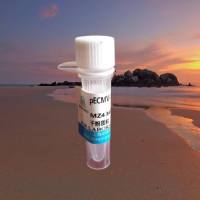
Eperythrozoon coccoides鼠附红细胞体(鼠嗜血支原体)染料法荧光定量PCR试剂盒上海圻明生物优势供应。更多产品资料欢迎免费咨询。
One of the many important uses of PCR technology is that it can be used to label DNA probes with high specific activity. PCR technology has high specificity, and can synthesize probe DNA fragments in quantities within 1~2h if [α-32P]dNTP or other markers are added to the substrate
dNTPs, the probe DNA can be well labeled during DNA synthesis, and the incorporation rate of the marker can be as high as 70%~80%. Therefore, PCR labeling technology is particularly suitable for large-scale detection and non-radiolabeling. The disadvantage of this method is that a specific pair of PCR primers is synthesized.
Labeling can also be achieved by using small fragments prepared from probe DNA as primers.
Solution preparation
1. Prepare a stock solution
Unless otherwise stated, all unused stock solutions should be divided into disposable aliquots and stored at -20 °C after preparation. Avoid repeated freeze-thaw cycles.
1.1* Acid Stock Solution (125X):
Add 20 μL DMSO to *ate (component B) to make a 125X* acid stock solution.
2. Prepare standard solutions
*Salt standard solution
Add 50 μL of 1 mM KH2PO4 (Component C) to 950 μL of deionized water or enzyme reaction buffer to give a 50 μM * saline standard solution (PS7). A 50 μM * saline standard solution (PS7) was taken and serially diluted 1:2 to obtain a serially diluted phosphate standard with deionized water or enzyme reaction buffer.
3. Prepare a working solution
Add 20 μL of 125X* stock solution to 2.5 mL of sterile H2O and mix well to make a working solution of *salt. Avoid potential Pi contamination. Note: Avoid direct exposure of *salts (component B) to light. Due to the high sensitivity of this assay to Pi, it is extremely important to use Pi-free labware and reagents.
风险提示:丁香通仅作为第三方平台,为商家信息发布提供平台空间。用户咨询产品时请注意保护个人信息及财产安全,合理判断,谨慎选购商品,商家和用户对交易行为负责。对于医疗器械类产品,请先查证核实企业经营资质和医疗器械产品注册证情况。
 文献和实验
文献和实验到20多种。 性传播疾病具有多种多样的病原体,包括细菌、真菌、螺旋体、衣原体、支原体、病毒、寄生虫等各类病原微生物。常见的病原体有: ①细菌:淋病双球菌、杜克雷嗜血杆菌、阴道加特纳氏杆菌等。②真菌:念珠菌等。③螺旋体:梅毒螺旋体。④衣原体:眼生殖器衣原休、性病性淋巴肉芽肿衣原体。⑤支原体:解脲支原体、生殖道支原体、人型支原体。⑥病毒:人乳头瘤病毒(6、11、 16、18型)、单纯疱疹病毒Ⅱ型、人类免疫缺陷病毒、传染性软疣病毒、乙型肝炎病毒、巨细胞病毒等。⑦
液相蛋白芯片技术由美国纳斯达克上市公司Luminex研制开发并于2O世纪9O年代中期发展起来,是在流式细胞技术、酶联免疫吸附试验(enzyme linked immunosorbent assay,ELISA)技术和传统芯片技术基础上开发的新一代生物芯片技术和新型蛋白质研究平台。液相蛋白芯片技术推动了功能基因组时代的蛋白质研究,相关的仪器、分析软件以及试剂盒研发备受瞩目并已形成一定的市场规模。现拟对该技术的基本原理、技术特点及其在免疫诊断和分析领域的研究和应用情况进行综合介绍。一、液相蛋白
之,以免污染整个培养环境。支原体的污染主要来源于牛血清,此外,其它添加剂、实验室工作人员及环境也可能造成支原体污染。在有条件的实验室,要对每一批小牛血清和长期传代培养的细胞系进行支原体的检查,查出污染源应及时采取措施处理。对于污染的杂交瘤细胞可以采取生物学的过滤方法,将污染的杂交瘤细胞注射于BALB/c小鼠的腹腔,待长出腹水或实体瘤时,�^菌取出分离杂交瘤细胞,一般可除去支原体污染。 2. 融合后杂交瘤不生长:在保证融合技术没有问题的前提下主要考虑下列因素①PEG有毒性或作用时间过长。②牛血
 技术资料
技术资料暂无技术资料 索取技术资料