

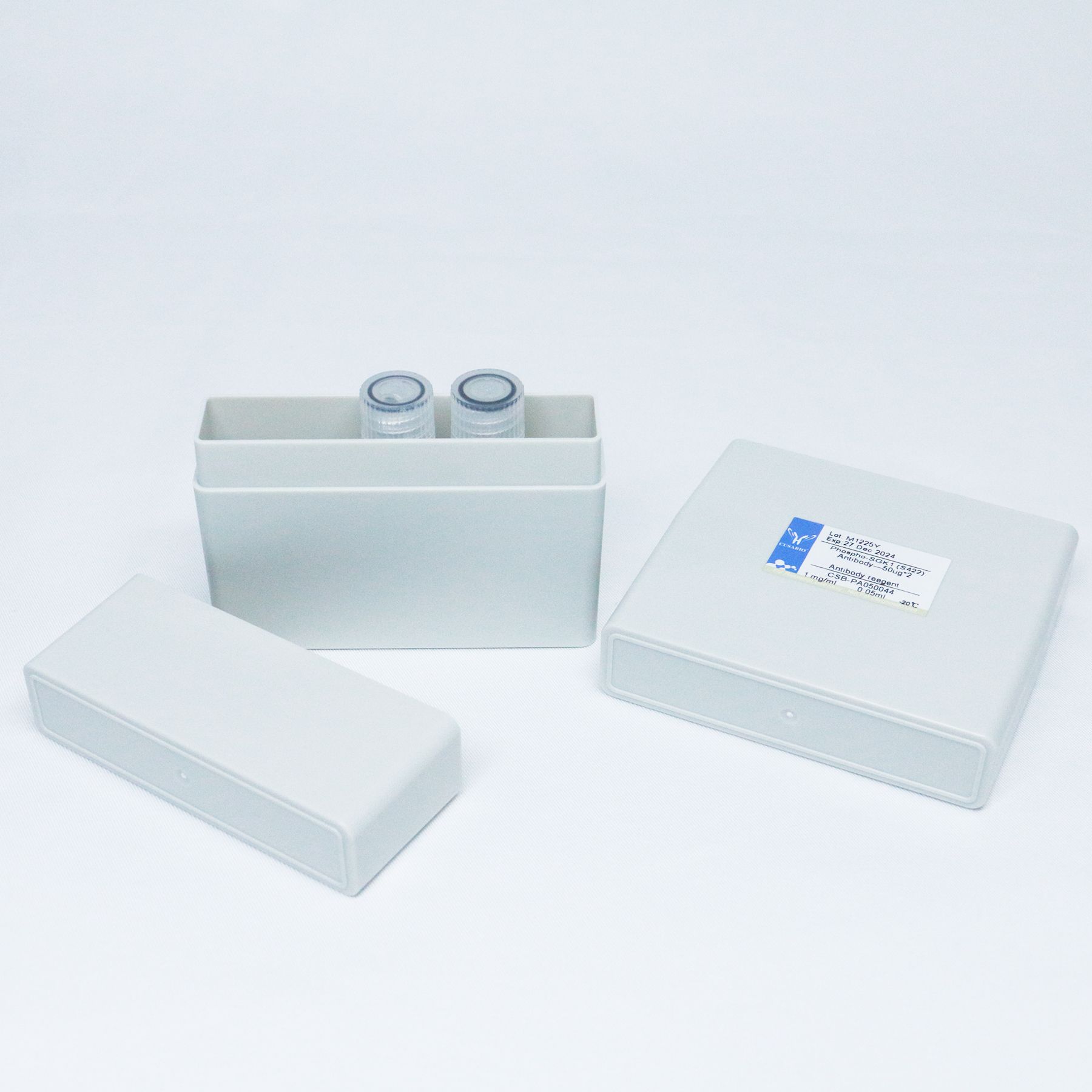
- ¥440 - 1320
- CUSABIO

- CN
- CSB-PA860777LA01HU
- 2025年07月15日
- ELISA, IHC, IF; Recommended dilution: IHC:1:20-1:200, IF:1:50-1:200
- Rabbit
- Human

企业认证
相关产品推荐更多 >

TUBA1A/TUBA1A Monoclonal 抗体/TUBA1A Monoclonal Antibody/单抗
询价
FBXW2抗体FBXW2兔多抗抗体Protein MD6 antibody抗体FBXW2 Antibody, Biotin conjugated抗体
¥880
/抗体/一抗抗体/抗体UBE2A/UBE2B Antibody抗体
¥880
TIPRL抗体TIPRL兔多抗抗体Type 2A-interacting protein antibody抗体TIPRL Antibody抗体
¥440
MIEN1抗体MIEN1兔多抗抗体XTP4 antibody抗体MIEN1 Antibody, FITC conjugated抗体
¥880
万千商家帮你免费找货
0 人在求购买到急需产品
相关阅读
AJE 润色服务限时 8 折起,权威机构信任 15+ 年Cytoscape 教程来了!快速实现顶刊同款通路网络图五大应用案例:Mustang Q 膜层析应用全解析1 个小工具,一次性搞定流程图、质粒图谱和信号通路图- 详细信息
- 文献和实验
- 技术资料
- 免疫原:
Recombinant Human Neuronal PAS domain-containing protein 2 protein (644-763AA)
- 亚型:
IgG
- 形态:
Liquid
- 保存条件:
Upon receipt, store at -20℃ or -80℃. Avoid repeated freeze.
- 克隆性:
Polyclonal
- 标记物:
Non-conjugated
- 适应物种:
Human
- 保质期:
6个月
- 抗原来源:
Homo sapiens (Human)
- 目录编号:
Q99743
- 级别:
优
- 库存:
200
- 供应商:
武汉华美生物工程有限公司
- 宿主:
Rabbit
- 应用范围:
ELISA, IHC, IF; Recommended dilution: IHC:1:20-1:200, IF:1:50-1:200
- 浓度:
>95%,Protein G purified
- 靶点:
NPAS2
- 抗体英文名:
NPAS2 Antibody
- 抗体名:
PASD4 antibody
- 规格:
100μg/50μg/20μg
| 规格: | 100μg | 产品价格: | ¥1320.0 |
|---|---|---|---|
| 规格: | 50μg | 产品价格: | ¥880.0 |
| 规格: | 20μg | 产品价格: | ¥440.0 |
保存缓冲液
Preservative: 0.03% Proclin 300Constituents: 50% Glycerol, 0.01M PBS, pH 7.4
功能
Transcriptional activator which forms a core component of the circadian clock. The circadian clock, an internal time-keeping system, regulates various physiological processes through the generation of approximately 24 hour circadian rhythms in gene expression, which are translated into rhythms in metabolism and behavior. It is derived from the Latin roots \'circa\' (about) and \'diem\' (day) and acts as an important regulator of a wide array of physiological functions including metabolism, sleep, body temperature, blood pressure, endocrine, immune, cardiovascular, and renal function. Consists of two major components: the central clock, residing in the suprachiasmatic nucleus (SCN) of the brain, and the peripheral clocks that are present in nearly every tissue and organ system. Both the central and peripheral clocks can be reset by environmental cues, also known as Zeitgebers (German for \'timegivers\'). The predominant Zeitgeber for the central clock is light, which is sensed by retina and signals directly to the SCN. The central clock entrains the peripheral clocks through neuronal and hormonal signals, body temperature and feeding-related cues, aligning all clocks with the external light/dark cycle. Circadian rhythms allow an organism to achieve temporal homeostasis with its environment at the molecular level by regulating gene expression to create a peak of protein expression once every 24 hours to control when a particular physiological process is most active with respect to the solar day. Transcription and translation of core clock components (CLOCK, NPAS2, ARNTL/BMAL1, ARNTL2/BMAL2, PER1, PER2, PER3, CRY1 and CRY2) plays a critical role in rhythm generation, whereas delays imposed by post-translational modifications (PTMs) are important for determining the period (tau) of the rhythms (tau refers to the period of a rhythm and is the length, in time, of one complete cycle). A diurnal rhythm is synchronized with the day/night cycle, while the ultradian and infradian rhythms have a period shorter and longer than 24 hours, respectively. Disruptions in the circadian rhythms contribute to the pathology of cardiovascular diseases, cancer, metabolic syndromes and aging. A transcription/translation feedback loop (TTFL) forms the core of the molecular circadian clock mechanism. Transcription factors, CLOCK or NPAS2 and ARNTL/BMAL1 or ARNTL2/BMAL2, form the positive limb of the feedback loop, act in the form of a heterodimer and activate the transcription of core clock genes and clock-controlled genes (involved in key metabolic processes), harboring E-box elements (5\'-CACGTG-3\') within their promoters. The core clock genes: PER1/2/3 and CRY1/2 which are transcriptional repressors form the negative limb of the feedback loop and interact with the CLOCK|NPAS2-ARNTL/BMAL1|ARNTL2/BMAL2 heterodimer inhibiting its activity and thereby negatively regulating their own expression. This heterodimer also activates nuclear receptors NR1D1/2 and RORA/B/G, which form a second feedback loop and which activate and repress ARNTL/BMAL1 transcription, respectively. The NPAS2-ARNTL/BMAL1 heterodimer positively regulates the expression of MAOA, F7 and LDHA and modulates the circadian rhythm of daytime contrast sensitivity by regulating the rhythmic expression of adenylate cyclase type 1 (ADCY1) in the retina. NPAS2 plays an important role in sleep homeostasis and in maintaining circadian behaviors in normal light/dark and feeding conditions and in the effective synchronization of feeding behavior with scheduled food availability. Regulates the gene transcription of key metabolic pathways in the liver and is involved in DNA damage response by regulating several cell cycle and DNA repair genes.风险提示:丁香通仅作为第三方平台,为商家信息发布提供平台空间。用户咨询产品时请注意保护个人信息及财产安全,合理判断,谨慎选购商品,商家和用户对交易行为负责。对于医疗器械类产品,请先查证核实企业经营资质和医疗器械产品注册证情况。
 文献和实验
文献和实验在免疫反应方面,基于抗原的刺激在体内形成、并与抗原作特异性结合的蛋白质之总称。其化学实质是免疫球蛋白。抗体,按照抗原抗体反应的类型可分别称为沉淀素、凝集素、溶血素、溶菌素、抗毒素、中和抗体等,但这些并不等于有相应的不同抗体存在,一般多只表明抗体反应的多样性而已。抗体在血清中含量最多(体液抗体=humoral antibody);含有某特定抗体的血清称为抗血或免疫血清。
机体在抗原物质刺激下,由B细胞分化成的浆细胞所产生的、可与相应抗原发生特异性结合反应的免疫球蛋白。因为最初有人用电泳证明血清中抗体活性在γ球蛋白部分,故曾把抗体统称为两种(γ)球蛋白。后来证明,抗体并不都在γ区;而且位于γ区的球蛋白,也不一定都具有抗体活性。1964年,世界卫生组织举行专门会议,将具有抗体活性以及与抗体相关的球蛋白统称为免疫球蛋白(Ig)。如骨髓瘤蛋白,巨球蛋白血症、冷球蛋白血症等患者血清中存在的异常免疫球蛋白以及“正常人”天然存在的免疫
指仅对一种抗原决定基的纯粹的抗体。这类抗体不可能通过将抗原 胞的 Hybridoma,在试管内制成了纯粹的单克隆抗体。用某种抗原使动物产生免疫感应,对应于抗原之不同部分可制成各种不同的抗体复合体。然而,因为一个产生抗体的细胞,只能产生一种抗体,所以骨髓肿瘤细胞与产生抗体细胞间的细胞杂种,可形成边产生抗体边增殖的 hybridoma,将每个杂种细胞进行克隆(无性繁殖系)培养,则一个克隆的细胞群只由单种类产生同一抗体的细胞所组成,这样得到的就是单克隆抗体。此抗体在测定
 技术资料
技术资料暂无技术资料 索取技术资料

