

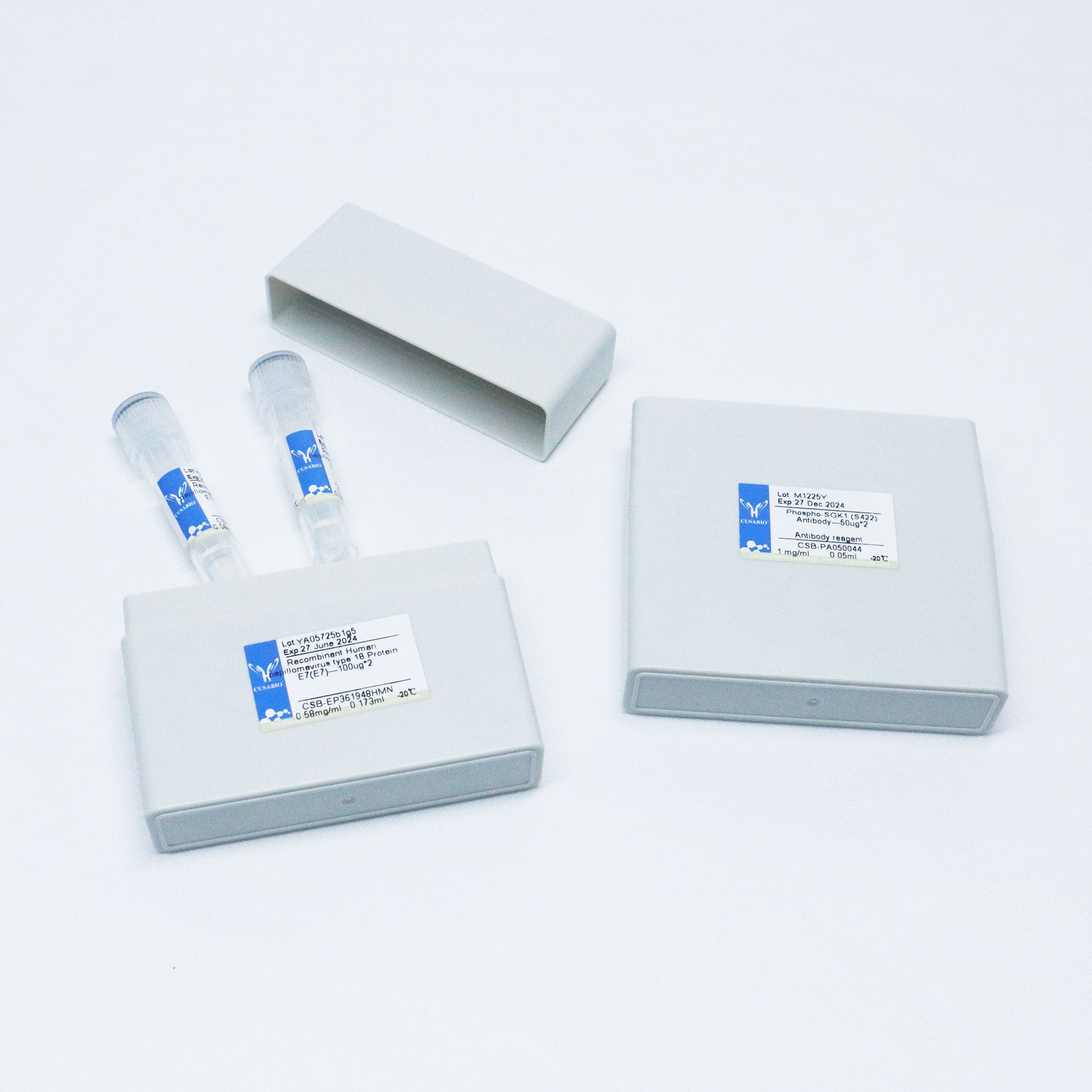
人MAPK14重组蛋白MAP kinase 14;MAPK
14;Cytokine suppressive anti-inflammatory drug-binding protein;CSAID-binding protein;CSBP;MAP kinase MXI2;MAX-interacting protein 2;Mitogen-activated protein kinase p38 alpha;MAP kinase p38 alpha;Stress-activated protein- ¥1836
- CUSABIO

- CN
- CSB-EP013453HUc0
- 2026年01月20日

企业认证
相关产品推荐更多 >
人PLAT重组蛋白INN: Alteplase INN: ReteplaseHuman Tissue-type plasminogen activator(PLAT)(R497Q)蛋白
¥1902
Recombinant-Rat-P2Y-purinoceptor-12P2ry12P2Y purinoceptor 12; P2Y12 Alternative name(s): P2Y12 platelet ADP receptor
¥11830
Recombinant-Klebsiella-pneumoniae-Cobalamin-synthasecobSCobalamin synthase EC= 2.-.-.-
¥10962Recombinant-Rhipicephalus-sanguineus-Cytochrome-c-oxidase-subunit-3COIIICytochrome c oxidase subunit 3 EC= 1.9.3.1 Alternative name(s): Cytochrome c oxidase polypeptide III
¥11060Recombinant-Mouse-Corticotropin-releasing-factor-receptor-2Crhr2Corticotropin-releasing factor receptor 2; CRF-R-2; CRF-R2; CRFR-2 Alternative name(s): CRF-RB Corticotropin-releasing hormone receptor 2; CRH-R-2 Sh
¥12404
万千商家帮你免费找货
0 人在求购买到急需产品
相关阅读
香烟烟雾如何加速声带纤维化?CD44-透明质酸轴是关键通路Cytoscape 教程来了!快速实现顶刊同款通路网络图五大应用案例:Mustang Q 膜层析应用全解析1 个小工具,一次性搞定流程图、质粒图谱和信号通路图- 详细信息
- 文献和实验
- 技术资料
- 保存条件:
We recommend to add 5-50% of glycerol (final concentration) and aliquot for long-term storage at -20℃/-80℃.
- 保质期:
Generally, the shelf life of liquid form is 6 months at -20℃/-80℃. The shelf life of lyophilized form is 12 months at -20℃/-80℃.
- 英文名:
Recombinant Human Mitogen-activated protein kinase 14 (MAPK14)
- 库存:
200
- 供应商:
武汉华美生物工程有限公司
- 规格:
20μg
英文名称:
Recombinant Human Mitogen-activated protein kinase 14 (MAPK14)品名简称:
Recombinant Human MAPK14 protein货号:
CSB-EP013453HUc0规格:
20μg价格:
1836LC-MS/Western Blot:
/SDS-PAGE:
(Tris-Glycine gel) Discontinuous SDS-PAGE (reduced) with 5% enrichment gel and 15% separation gel.纯度:
Greater than 90% as determined by SDS-PAGE.内毒素:
Not test生物活性:
/基因名:
MAPK14Uniprot No.:
Q16539别名:
MAP kinase 14;MAPK 14;Cytokine suppressive anti-inflammatory drug-binding protein;CSAID-binding protein;CSBP;MAP kinase MXI2;MAX-interacting protein 2;Mitogen-activated protein kinase p38 alpha;MAP kinase p38 alpha;Stress-activated protein kinase 2a;SAPK2a种属:
Homo sapiens (Human)蛋白长度:
Full Length of Mature Protein来源:
E.coli分子量:
72.6 kDa表达区域:
2-360aa氨基酸序列:
SQERPTFYRQELNKTIWEVPERYQNLSPVGSGAYGSVCAAFDTKTGLRVAVKKLSRPFQSIIHAKRTYRELRLLKHMKHENVIGLLDVFTPARSLEEFNDVYLVTHLMGADLNNIVKCQKLTDDHVQFLIYQILRGLKYIHSADIIHRDLKPSNLAVNEDCELKILDFGLARHTDDEMTGYVATRWYRAPEIMLNWMHYNQTVDIWSVGCIMAELLTGRTLFPGTDHIDQLKLILRLVGTPGAELLKKISSESARNYIQSLTQMPKMNFANVFIGANPLAVDLLEKMLVLDSDKRITAAQALAHAYFAQYHDPDDEPVADPYDQSFESRDLLIDEWKSLTYDEVISFVPPPLDQEEMES蛋白标签:
N-terminal 6xHis-GST-tagged产品提供形式:
Liquid or Lyophilized powder缓冲液:
If the delivery form is liquid, the default storage buffer is Tris/PBS-based buffer, 5%-50% glycerol. If the delivery form is lyophilized powder, the buffer before lyophilization is Tris/PBS-based buffer, 6% Trehalose, pH 8.0.储存条件:
We recommend that this vial be briefly centrifuged prior to opening to bring the contents to the bottom. Please reconstitute protein in deionized sterile water to a concentration of 0.1-1.0 mg/mL.We recommend to add 5-50% of glycerol (final concentration) and aliquot for long-term storage at -20℃/-80℃. Our default final concentration of glycerol is 50%. Customers could use it as reference.保质期:
The shelf life is related to many factors, storage state, buffer ingredients, storage temperature and the stability of the protein itself. Generally, the shelf life of liquid form is 6 months at -20℃/-80℃. The shelf life of lyophilized form is 12 months at -20℃/-80℃.货期:
13-23 business days注意事项:
Repeated freezing and thawing is not recommended. Store working aliquots at 4℃ for up to one week.功能1:
Serine/threonine kinase which acts as an essential component of the MAP kinase signal transduction pathway. MAPK14 is one of the four p38 MAPKs which play an important role in the cascades of cellular responses evoked by extracellular stimuli such as pro-inflammatory cytokines or physical stress leading to direct activation of transcription factors. Accordingly, p38 MAPKs phosphorylate a broad range of proteins and it has been estimated that they may have approximately 200 to 300 substrates each. Some of the targets are downstream kinases which are activated through phosphorylation and further phosphorylate additional targets. RPS6KA5/MSK1 and RPS6KA4/MSK2 can directly phosphorylate and activate transcription factors such as CREB1, ATF1, the NF-kappa-B isoform RELA/NFKB3, STAT1 and STAT3, but can also phosphorylate histone H3 and the nucleosomal protein HMGN1. RPS6KA5/MSK1 and RPS6KA4/MSK2 play important roles in the rapid induction of immediate-early genes in response to stress or mitogenic stimuli, either by inducing chromatin remodeling or by recruiting the transcription machinery. On the other hand, two other kinase targets, MAPKAPK2/MK2 and MAPKAPK3/MK3, participate in the control of gene expression mostly at the post-transcriptional level, by phosphorylating ZFP36 (tristetraprolin) and ELAVL1, and by regulating EEF2K, which is important for the elongation of mRNA during translation. MKNK1/MNK1 and MKNK2/MNK2, two other kinases activated by p38 MAPKs, regulate protein synthesis by phosphorylating the initiation factor EIF4E2. MAPK14 interacts also with casein kinase II, leading to its activation through autophosphorylation and further phosphorylation of TP53/p53. In the cytoplasm, the p38 MAPK pathway is an important regulator of protein turnover. For example, CFLAR is an inhibitor of TNF-induced apoptosis whose proteasome-mediated degradation is regulated by p38 MAPK phosphorylation. In a similar way, MAPK14 phosphorylates the ubiquitin ligase SIAH2, regulating its activity towards EGLN3. MAPK14 may also inhibit the lysosomal degradation pathway of autophagy by interfering with the intracellular trafficking of the transmembrane protein ATG9. Another function of MAPK14 is to regulate the endocytosis of membrane receptors by different mechanisms that impinge on the small GTPase RAB5A. In addition, clathrin-mediated EGFR internalization induced by inflammatory cytokines and UV irradiation depends on MAPK14-mediated phosphorylation of EGFR itself as well as of RAB5A effectors. Ectodomain shedding of transmembrane proteins is regulated by p38 MAPKs as well. In response to inflammatory stimuli, p38 MAPKs phosphorylate the membrane-associated metalloprotease ADAM17. Such phosphorylation is required for ADAM17-mediated ectodomain shedding of TGF-alpha family ligands, which results in the activation of EGFR signaling and cell proliferation. Another p38 MAPK substrate is FGFR1. FGFR1 can be translocated from the extracellular space into the cytosol and nucleus of target cells, and regulates processes such as rRNA synthesis and cell growth. FGFR1 translocation requires p38 MAPK activation. In the nucleus, many transcription factors are phosphorylated and activated by p38 MAPKs in response to different stimuli. Classical examples include ATF1, ATF2, ATF6, ELK1, PTPRH, DDIT3, TP53/p53 and MEF2C and MEF2A. The p38 MAPKs are emerging as important modulators of gene expression by regulating chromatin modifiers and remodelers. The promoters of several genes involved in the inflammatory response, such as IL6, IL8 and IL12B, display a p38 MAPK-dependent enrichment of histone H3 phosphorylation on 'Ser-10' (H3S10ph) in LPS-stimulated myeloid cells. This phosphorylation enhances the accessibility of the cryptic NF-kappa-B-binding sites marking promoters for increased NF-kappa-B recruitment. Phosphorylates CDC25B and CDC25C which is required for binding to 14-3-3 proteins and leads to initiation of a G2 delay after ultraviolet radiation. Phosphorylates TIAR following DNA damage, releasing TIAR from GADD45A mRNA and preventing mRNA degradation. The p38 MAPKs may also have kinase-independent roles, which are thought to be due to the binding to targets in the absence of phosphorylation. Protein O-Glc-N-acylation catalyzed by the OGT is regulated by MAPK14, and, although OGT does not seem to be phosphorylated by MAPK14, their interaction increases upon MAPK14 activation induced by glucose deprivation. This interaction may regulate OGT activity by recruiting it to specific targets such as neurofilament H, stimulating its O-Glc-N-acylation. Required in mid-fetal development for the growth of embryo-derived blood vessels in the labyrinth layer of the placenta. Also plays an essential role in developmental and stress-induced erythropoiesis, through regulation of EPO gene expression. Isoform MXI2 activation is stimulated by mitogens and oxidative stress and only poorly phosphorylates ELK1 and ATF2. Isoform EXIP may play a role in the early onset of apoptosis. Phosphorylates S100A9 at 'Thr-113'. ; (Microbial infection) Activated by phosphorylation by M.tuberculosis EsxA in T-cells leading to inhibition of IFN-gamma production; phosphorylation is apparent within 15 minutes and is inhibited by kinase-specific inhibitors SB203580 and siRNA.功能2:
/文献:
/研究领域:
Immunology请点击“在线询价”找客服索取产品说明书及引用文献目录,产品实时更新参数、价格信息、更多文献信息可以查看cusabio官网
风险提示:丁香通仅作为第三方平台,为商家信息发布提供平台空间。用户咨询产品时请注意保护个人信息及财产安全,合理判断,谨慎选购商品,商家和用户对交易行为负责。对于医疗器械类产品,请先查证核实企业经营资质和医疗器械产品注册证情况。
 文献和实验
文献和实验Tyrosine Kinase Inhibitors Against EGF Receptor-Positive Malignancies
epidermal growth factor receptor (EGFR) (1 –6 ), Janus kinases (JAKs) (7 –13 ), Bruton’s tyrosine kinase (BTK) (14 –16 ), platelet-derived growth factor (PDGF) (17 ), protein kinase C (PKC) (18 –24 ), Lck (25 , 26 ), Trk (27 –30
【求助】急急求助答案——关于SB203580抑制P38MAPK的自身磷酸化
-permeable inhibitor of p38 kinase (IC50 = 34 nM in vitro, 600 nM in cells). Also known as reactivating kinase (RK) and CSBP (cytokine synthesis anti-inflammatory drug binding protein). Does not significantly inhibit JNK or p42 MAP kinase even at 100 µM
cAMP-dependent protein kinase (PKA) is involved in various cellular functions such as cell proliferation, gene induction, and metabolism (1 ,2 ) and its regulatory subunits have been suggested as a drug target for cancer and other diseases
 技术资料
技术资料暂无技术资料 索取技术资料

