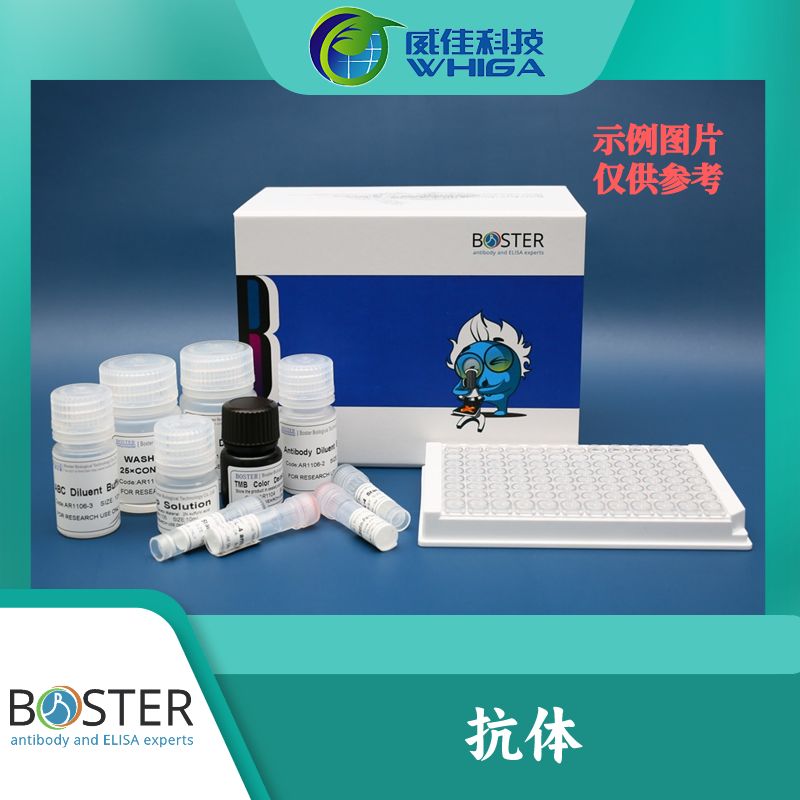
- ¥1960
- BOSTER

- PB9481-100ul
- 中国
- 2025年07月13日

企业认证
相关产品推荐更多 >
万千商家帮你免费找货
0 人在求购买到急需产品
- 详细信息
- 技术资料
- 库存:
大量
- 供应商:
广州威佳科技有限公司
- 规格:
100ul
产品概况
| 货号 | PB9481 |
|---|---|
| 产品名称 | Anti-ATG14 Antibody |
| 基因名 | ATG14 |
| 抗体来源 | Rabbit |
| 克隆 | Polyclonal |
| 抗体亚型 | Rabbit IgG |
| 分子量 | 59KD |
| 免疫原 | A synthetic peptide corresponding to a sequence at the N-terminus of human ATG14L (70-101aa RDRERFIDKKERLSRLKSKQEEFQKEVLKAME), different from the related mouse and rat sequences by two amino acids. |
| 内容 | 500 ug/ml antibody with PBS ,0.02% NaN3 , 1 mg BSA and 50% glycerol. |
| 纯化方式 | Immunogen affinity purified. |
| 浓度 | 500 ug/ml |
| 产品形态 | Liquid |
| 保存条件 | 12 months from date of receipt,-20℃ as supplied. 6 months 2 to 8℃ after reconstitution. Avoid repeated freezing and thawing. |
| 背景资料 | ATG14 (also known as beclin-1-associated autophagy-related key regulator (Barkor) or ATG14L), an essential autophagy-specific regulator of the class III phosphatidylinositol 3-kinase complex, promotes membrane tethering of protein-free liposomes, and enhances hemifusion and full fusion of proteoliposomes reconstituted with the target (t)-SNAREs (soluble N-ethylmaleimide-sensitive factor attachment protein receptors) syntaxin 17 (STX17) and SNAP29, and the vesicle (v)-SNARE VAMP8 (vesicle-associated membrane protein 8). ATG14 binds to the SNARE core domain of STX17 through its coiled-coil domain, and stabilizes the STX17-SNAP29 binary t-SNARE complex on autophagosomes. |
| 研究类别 | 1. Diao J; Liu R; Rong Y; Zhao M; Zhang J; Lai Y; Zhou Q; Wilz LM; Li J; Vivona S; Pfuetzner RA; Brunger AT; Zhong Q. “ATG14 promotes membrane tethering and fusion of autophagosomes to endolysosomes”. Nature, 2015 Apr 23. |
| Uniprot ID | ATG14: Q6ZNE5 |
| 推荐配套的二抗和检测试剂 | Boster recommends Enhanced Chemiluminescent Kit with anti-Rabbit IgG (EK1002) for Western blot, and HRP Conjugated anti-Rabbit IgG Super Vision Assay Kit (SV0002-1) for IHC(P). *Blocking peptide 可以联系我们购买。 |
产品应用细节
为了提供优质的抗体,博士德对每一批抗体都用没有转染过的细胞系和体细胞组织检测,以保证博士德出品的抗体有足够的亲和性足以和对应蛋白天然的表达含量起反应。
| 应用 | 稀释度* |
|---|---|
| Western blot (WB): | 1:500-2000 |
| Immunohistochemistry in paraffin section (IHC): | 1:50-400 |
| Immunofluorescence (IF): | 1:50-400 |
| Immunocytochemistry/Immunofluorescence (ICC/IF): | 1:50-400 |
| Flow cytometry (FCM): | 1-3 μg/1x106 cells |
| (Boiling the paraffin sections in 10mM citrate buffer,pH6.0,or PH8.0 EDTA repair liquid for 20 mins is required for the staining of formalin/paraffin sections.) Optimal working dilutions must be determined by end user. | |
*稀释度需要用户自己调试,此处数据仅供参考。
**博士德提供高敏感的二抗和检测试剂盒。详情见相关产品推荐。
产品图片描述
点击图片放大
[list_product_images]Figure 1. Western blot analysis of ATG14L using anti-ATG14L antibody (PB9481). Electrophoresis was performed on a 5-20% SDS-PAGE gel at 70V (Stacking gel) / 90V (Resolving gel) for 2-3 hours. The sample well of each lane was loaded with 50ug of sample under reducing conditions. Lane 1: Rat Brain Tissue Lysate,Lane 2: HELA Whole Cell Lysate. After Electrophoresis, proteins were transferred to a Nitrocellulose membrane at 150mA for 50-90 minutes. Blocked the membrane with 5% Non-fat Milk/ TBS for 1.5 hour at RT. The membrane was incubated with rabbit anti-ATG14L antigen affinity purified polyclonal antibody (Catalog # PB9481) at 0.5 μg/mL overnight at 4°C, then washed with TBS-0.1%Tween 3 times with 5 minutes each and probed with a goat anti-rabbit IgG-HRP secondary antibody at a dilution of 1:10000 for 1.5 hour at RT. The signal is developed using an Enhanced Chemiluminescent detection (ECL) kit (Catalog # EK1002) with Tanon 5200 system. A specific band was detected for ATG14L at approximately 59KD. The expected band size for ATG14L is at 59KD.|Figure 2. IHC analysis of ATG14L using anti-ATG14L antibody (PB9481).ATG14L was detected in paraffin-embedded section of Rat Spleen Tissue. Heat mediated antigen retrieval was performed in citrate buffer (pH6, epitope retrieval solution) for 20 mins. The tissue section was blocked with 10% goat serum. The tissue section was then incubated with 1μg/ml rabbit anti-ATG14L Antibody (PB9481) overnight at 4°C. Biotinylated goat anti-rabbit IgG was used as secondary antibody and incubated for 30 minutes at 37°C. The tissue section was developed using Strepavidin-Biotin-Complex (SABC)(Catalog # SA1022) with DAB as the chromogen. |Figure 3. IHC analysis of ATG14L using anti-ATG14L antibody (PB9481).ATG14L was detected in paraffin-embedded section of Human Lung Cancer Tissue. Heat mediated antigen retrieval was performed in citrate buffer (pH6, epitope retrieval solution) for 20 mins. The tissue section was blocked with 10% goat serum. The tissue section was then incubated with 1μg/ml rabbit anti-ATG14L Antibody (PB9481) overnight at 4°C. Biotinylated goat anti-rabbit IgG was used as secondary antibody and incubated for 30 minutes at 37°C. The tissue section was developed using Strepavidin-Biotin-Complex (SABC)(Catalog # SA1022) with DAB as the chromogen. |Figure 4. IF analysis of ATG14 using anti-ATG14 antibody (PB9481).
ATG14 was detected in an immunocytochemical section of U2OS cells. Cy3-conjugated Anti-rabbit IgG Secondary Antibody (red)(Catalog#BA1032) was used as secondary antibody. The section was counterstained with DAPI (Catalog # AR1176) (Blue). |Figure 5. IF analysis of ATG14 using anti-ATG14 antibody (PB9481).
ATG14 was detected in a paraffin-embedded section of human lung cancer tissue. Cy3-conjugated Anti-rabbit IgG Secondary Antibody (red)(Catalog#BA1032) was used as secondary antibody. The section was counterstained with DAPI (Catalog # AR1176) (Blue). |Figure 6. IF analysis of ATG14 using anti-ATG14 antibody (PB9481).
ATG14 was detected in a paraffin-embedded section of human colon cancer tissue. Cy3-conjugated Anti-rabbit IgG Secondary Antibody (red)(Catalog#BA1032) was used as secondary antibody. The section was counterstained with DAPI (Catalog # AR1176) (Blue). |Figure 7. IF analysis of ATG14 using anti-ATG14 antibody (PB9481).
ATG14 was detected in a paraffin-embedded section of rat spleen tissue. Cy3-conjugated Anti-rabbit IgG Secondary Antibody (red)(Catalog#BA1032) was used as secondary antibody. The section was counterstained with DAPI (Catalog # AR1176) (Blue). |Figure 8. Flow Cytometry analysis of SiHa cells using anti-ATG14L antibody (PB9481).Overlay histogram showing SiHa cells stained with PB9481 (Blue line).The cells were blocked with 10% normal goat serum. And then incubated with rabbit anti-ATG14L Antibody (PB9481,1μg/1x106 cells) for 30 min at 20°C. DyLight®488 conjugated goat anti-rabbit IgG (BA1127, 5-10μg/1x106 cells) was used as secondary antibody for 30 minutes at 20°C. Isotype control antibody (Green line) was rabbit IgG (1μg/1x106) used under the same conditions. Unlabelled sample (Red line) was also used as a control.|Figure 9. Flow Cytometry analysis of A431 cells using anti-ATG14L antibody (PB9481).Overlay histogram showing A431 cells stained with PB9481 (Blue line).The cells were blocked with 10% normal goat serum. And then incubated with rabbit anti-ATG14L Antibody (PB9481,1μg/1x106 cells) for 30 min at 20°C. DyLight®488 conjugated goat anti-rabbit IgG (BA1127, 5-10μg/1x106 cells) was used as secondary antibody for 30 minutes at 20°C. Isotype control antibody (Green line) was rabbit IgG (1μg/1x106) used under the same conditions. Unlabelled sample (Red line) was also used as a control.|Figure 10. Flow Cytometry analysis of PC-3 cells using anti-ATG14L antibody (PB9481).Overlay histogram showing PC-3 cells stained with PB9481 (Blue line).The cells were blocked with 10% normal goat serum. And then incubated with rabbit anti-ATG14L Antibody (PB9481,1μg/1x106 cells) for 30 min at 20°C. DyLight®488 conjugated goat anti-rabbit IgG (BA1127, 5-10μg/1x106 cells) was used as secondary antibody for 30 minutes at 20°C. Isotype control antibody (Green line) was rabbit IgG (1μg/1x106) used under the same conditions. Unlabelled sample (Red line) was also used as a control.[/list_product_images]
ATG14 was detected in an immunocytochemical section of U2OS cells. Cy3-conjugated Anti-rabbit IgG Secondary Antibody (red)(Catalog#BA1032) was used as secondary antibody. The section was counterstained with DAPI (Catalog # AR1176) (Blue). |Figure 5. IF analysis of ATG14 using anti-ATG14 antibody (PB9481).
ATG14 was detected in a paraffin-embedded section of human lung cancer tissue. Cy3-conjugated Anti-rabbit IgG Secondary Antibody (red)(Catalog#BA1032) was used as secondary antibody. The section was counterstained with DAPI (Catalog # AR1176) (Blue). |Figure 6. IF analysis of ATG14 using anti-ATG14 antibody (PB9481).
ATG14 was detected in a paraffin-embedded section of human colon cancer tissue. Cy3-conjugated Anti-rabbit IgG Secondary Antibody (red)(Catalog#BA1032) was used as secondary antibody. The section was counterstained with DAPI (Catalog # AR1176) (Blue). |Figure 7. IF analysis of ATG14 using anti-ATG14 antibody (PB9481).
ATG14 was detected in a paraffin-embedded section of rat spleen tissue. Cy3-conjugated Anti-rabbit IgG Secondary Antibody (red)(Catalog#BA1032) was used as secondary antibody. The section was counterstained with DAPI (Catalog # AR1176) (Blue). |Figure 8. Flow Cytometry analysis of SiHa cells using anti-ATG14L antibody (PB9481).Overlay histogram showing SiHa cells stained with PB9481 (Blue line).The cells were blocked with 10% normal goat serum. And then incubated with rabbit anti-ATG14L Antibody (PB9481,1μg/1x106 cells) for 30 min at 20°C. DyLight®488 conjugated goat anti-rabbit IgG (BA1127, 5-10μg/1x106 cells) was used as secondary antibody for 30 minutes at 20°C. Isotype control antibody (Green line) was rabbit IgG (1μg/1x106) used under the same conditions. Unlabelled sample (Red line) was also used as a control.|Figure 9. Flow Cytometry analysis of A431 cells using anti-ATG14L antibody (PB9481).Overlay histogram showing A431 cells stained with PB9481 (Blue line).The cells were blocked with 10% normal goat serum. And then incubated with rabbit anti-ATG14L Antibody (PB9481,1μg/1x106 cells) for 30 min at 20°C. DyLight®488 conjugated goat anti-rabbit IgG (BA1127, 5-10μg/1x106 cells) was used as secondary antibody for 30 minutes at 20°C. Isotype control antibody (Green line) was rabbit IgG (1μg/1x106) used under the same conditions. Unlabelled sample (Red line) was also used as a control.|Figure 10. Flow Cytometry analysis of PC-3 cells using anti-ATG14L antibody (PB9481).Overlay histogram showing PC-3 cells stained with PB9481 (Blue line).The cells were blocked with 10% normal goat serum. And then incubated with rabbit anti-ATG14L Antibody (PB9481,1μg/1x106 cells) for 30 min at 20°C. DyLight®488 conjugated goat anti-rabbit IgG (BA1127, 5-10μg/1x106 cells) was used as secondary antibody for 30 minutes at 20°C. Isotype control antibody (Green line) was rabbit IgG (1μg/1x106) used under the same conditions. Unlabelled sample (Red line) was also used as a control.[/list_product_images]
风险提示:丁香通仅作为第三方平台,为商家信息发布提供平台空间。用户咨询产品时请注意保护个人信息及财产安全,合理判断,谨慎选购商品,商家和用户对交易行为负责。对于医疗器械类产品,请先查证核实企业经营资质和医疗器械产品注册证情况。
 技术资料
技术资料暂无技术资料 索取技术资料
Anti-ATG14LAntibody(原货号PB0503)(PB9481-100ul)
¥1960