

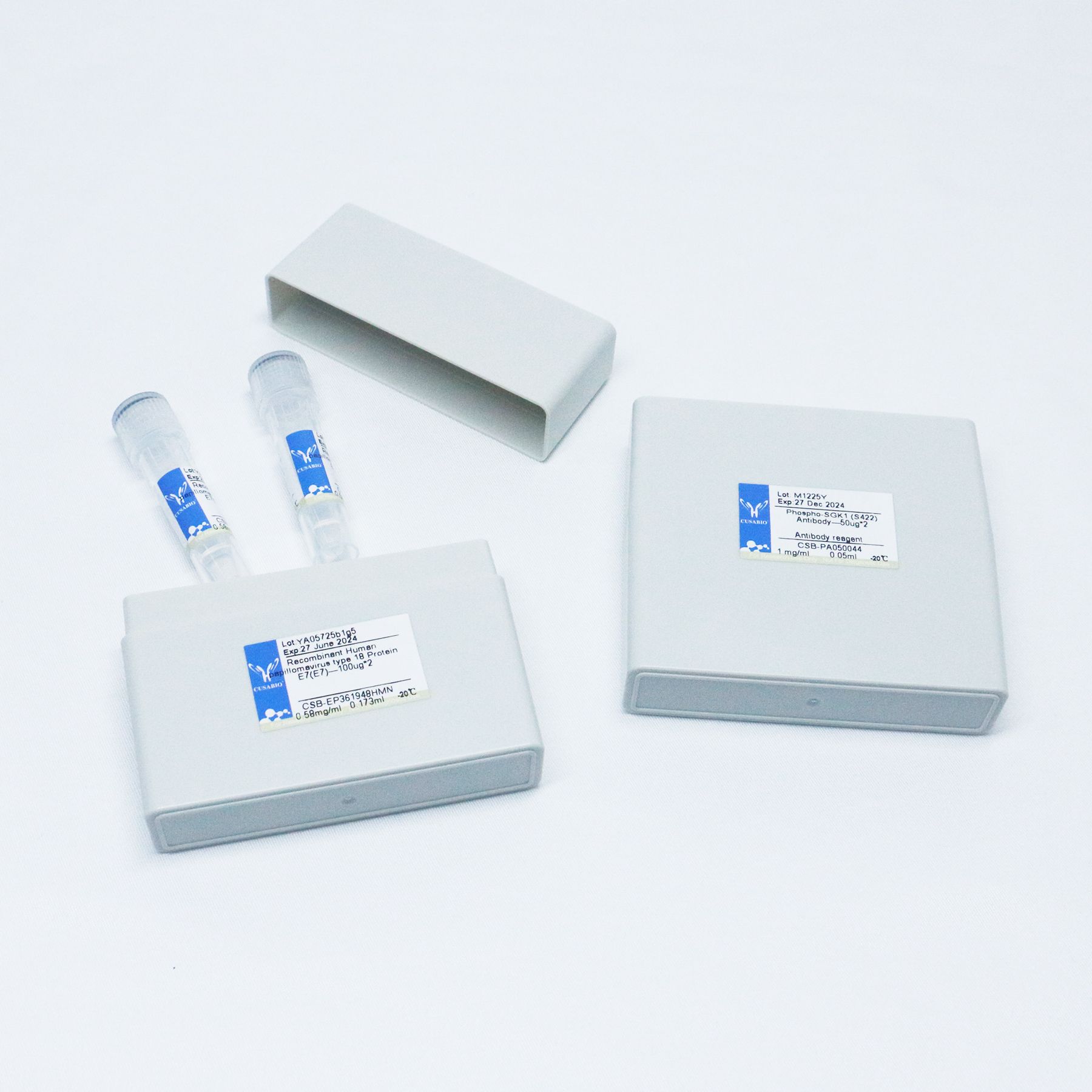
- ¥2328
- CUSABIO

- CN
- CSB-EP002135BO1
- 2026年01月20日

企业认证
相关产品推荐更多 >
Recombinant-Rat-Aquaporin-9Aqp9Aquaporin-9; AQP-9 Alternative name(s): Aquaglyceroporin-9
¥11396
Recombinant-Arabidopsis-thaliana-Reticulon-like-protein-B22RTNLB22Reticulon-like protein B22; AtRTNLB22
¥10234
人KRT18重组蛋白Cell proliferation-inducing gene 46 protein Cytokeratin-18 Short name: CK-18 Keratin-18 Short name: K18Human Keratin, type I cytoskeletal 18(KRT18)蛋白
¥2400
Recombinant-Hordeum-vulgare-Chloroplast-envelope-membrane-proteincemAChloroplast envelope membrane protein
¥10822
人CCL16重组蛋白Chemokine CC-4;HCC-4;Chemokine LEC;IL-10-inducible chemokine;LCC-1;Liver-expressed chemokineLymphocyte and monocyte chemoattractant;LMCMonotactin-1;MTN-1NCC-4;Small-inducible cytokine A16Human C-C motif chemokine 16(CCL16)蛋白
¥1344
万千商家帮你免费找货
0 人在求购买到急需产品
相关阅读
AJE 润色服务限时 8 折起,权威机构信任 15+ 年Cytoscape 教程来了!快速实现顶刊同款通路网络图五大应用案例:Mustang Q 膜层析应用全解析1 个小工具,一次性搞定流程图、质粒图谱和信号通路图- 详细信息
- 文献和实验
- 技术资料
- 保存条件:
We recommend to add 5-50% of glycerol (final concentration) and aliquot for long-term storage at -20℃/-80℃.
- 保质期:
Generally, the shelf life of liquid form is 6 months at -20℃/-80℃. The shelf life of lyophilized form is 12 months at -20℃/-80℃.
- 英文名:
Recombinant Bovine Beta-arrestin-2 (ARRB2), partial
- 库存:
200
- 供应商:
武汉华美生物工程有限公司
- 规格:
20μg
英文名称:
Recombinant Bovine Beta-arrestin-2 (ARRB2), partial品名简称:
Recombinant Bovine ARRB2 protein, partial货号:
CSB-EP002135BO1规格:
20μg价格:
2328LC-MS/Western Blot:
/SDS-PAGE:
(Tris-Glycine gel) Discontinuous SDS-PAGE (reduced) with 5% enrichment gel and 15% separation gel.纯度:
Greater than 90% as determined by SDS-PAGE.内毒素:
Not test生物活性:
/基因名:
ARRB2Uniprot No.:
P32120别名:
(Arrestin beta-2)(Arrestin-3)种属:
Bos taurus (Bovine)蛋白长度:
Partial来源:
E.coli分子量:
51.5 kDa表达区域:
240-420aa氨基酸序列:
ADICLFSTAQYKCPVAQVEQDDQVSPSSTFCKVYTITPLLSNNREKRGLALDGKLKHEDTNLASSTIVKEGANKEVLGILVSYRVKVKLVVSRGGDVSVELPFVLMHPKPHDHIALPRPQSAATHPPTLLPSAVPETDAPVDTNLIEFETNYATDDDIVFEDFARLRLKGLKDEDYDDQFC蛋白标签:
N-terminal 6xHis-GST-tagged产品提供形式:
Liquid or Lyophilized powder缓冲液:
If the delivery form is liquid, the default storage buffer is Tris/PBS-based buffer, 5%-50% glycerol. If the delivery form is lyophilized powder, the buffer before lyophilization is Tris/PBS-based buffer, 6% Trehalose, pH 8.0.储存条件:
We recommend that this vial be briefly centrifuged prior to opening to bring the contents to the bottom. Please reconstitute protein in deionized sterile water to a concentration of 0.1-1.0 mg/mL.We recommend to add 5-50% of glycerol (final concentration) and aliquot for long-term storage at -20℃/-80℃. Our default final concentration of glycerol is 50%. Customers could use it as reference.保质期:
The shelf life is related to many factors, storage state, buffer ingredients, storage temperature and the stability of the protein itself. Generally, the shelf life of liquid form is 6 months at -20℃/-80℃. The shelf life of lyophilized form is 12 months at -20℃/-80℃.货期:
13-23 business days注意事项:
Repeated freezing and thawing is not recommended. Store working aliquots at 4℃ for up to one week.功能1:
Functions in regulating agonist-mediated G-protein coupled receptor (GPCR) signaling by mediating both receptor desensitization and resensitization processes. During homologous desensitization, beta-arrestins bind to the GPRK-phosphorylated receptor and sterically preclude its coupling to the cognate G-protein; the binding appears to require additional receptor determinants exposed only in the active receptor conformation. The beta-arrestins target many receptors for internalization by acting as endocytic adapters (CLASPs, clathrin-associated sorting proteins) and recruiting the GPRCs to the adapter protein 2 complex 2 (AP-2) in clathrin-coated pits (CCPs). However, the extent of beta-arrestin involvement appears to vary significantly depending on the receptor, agonist and cell type. Internalized arrestin-receptor complexes traffic to intracellular endosomes, where they remain uncoupled from G-proteins. Two different modes of arrestin-mediated internalization occur. Class A receptors, like ADRB2, OPRM1, ENDRA, D1AR and ADRA1B dissociate from beta-arrestin at or near the plasma membrane and undergo rapid recycling. Class B receptors, like AVPR2, AGTR1, NTSR1, TRHR and TACR1 internalize as a complex with arrestin and traffic with it to endosomal vesicles, presumably as desensitized receptors, for extended periods of time. Receptor resensitization then requires that receptor-bound arrestin is removed so that the receptor can be dephosphorylated and returned to the plasma membrane. Mediates endocytosis of CCR7 following ligation of CCL19 but not CCL21. Involved in internalization of P2RY1, P2RY4, P2RY6 and P2RY11 and ATP-stimulated internalization of P2RY2. Involved in phosphorylation-dependent internalization of OPRD1 and subsequent recycling or degradation. Involved in ubiquitination of IGF1R. Beta-arrestins function as multivalent adapter proteins that can switch the GPCR from a G-protein signaling mode that transmits short-lived signals from the plasma membrane via small molecule second messengers and ion channels to a beta-arrestin signaling mode that transmits a distinct set of signals that are initiated as the receptor internalizes and transits the intracellular compartment. Acts as signaling scaffold for MAPK pathways such as MAPK1/3 (ERK1/2) and MAPK10 (JNK3). ERK1/2 and JNK3 activated by the beta-arrestin scaffold are largely excluded from the nucleus and confined to cytoplasmic locations such as endocytic vesicles, also called beta-arrestin signalosomes. Acts as signaling scaffold for the AKT1 pathway. GPCRs for which the beta-arrestin-mediated signaling relies on both ARRB1 and ARRB2 (codependent regulation) include ADRB2, F2RL1 and PTH1R. For some GPCRs the beta-arrestin-mediated signaling relies on either ARRB1 or ARRB2 and is inhibited by the other respective beta-arrestin form (reciprocal regulation). Increases ERK1/2 signaling in AGTR1- and AVPR2-mediated activation (reciprocal regulation). Involved in CCR7-mediated ERK1/2 signaling involving ligand CCL19. Is involved in type-1A angiotensin II receptor/AGTR1-mediated ERK activity. Is involved in type-1A angiotensin II receptor/AGTR1-mediated MAPK10 activity. Is involved in dopamine-stimulated AKT1 activity in the striatum by disrupting the association of AKT1 with its negative regulator PP2A. Involved in AGTR1-mediated chemotaxis. Appears to function as signaling scaffold involved in regulation of MIP-1-beta-stimulated CCR5-dependent chemotaxis. Involved in attenuation of NF-kappa-B-dependent transcription in response to GPCR or cytokine stimulation by interacting with and stabilizing CHUK. Suppresses UV-induced NF-kappa-B-dependent activation by interacting with CHUK. The function is promoted by stimulation of ADRB2 and dephosphorylation of ARRB2. Involved in p53/TP53-mediated apoptosis by regulating MDM2 and reducing the MDM2-mediated degradation of p53/TP53. May serve as nuclear messenger for GPCRs. Upon stimulation of OR1D2, may be involved in regulation of gene expression during the early processes of fertilization. Also involved in regulation of receptors other than GPCRs. Involved in endocytosis of TGFBR2 and TGFBR3 and down-regulates TGF-beta signaling such as NF-kappa-B activation. Involved in endocytosis of low-density lipoprotein receptor/LDLR. Involved in endocytosis of smoothened homolog/Smo, which also requires GRK2. Involved in endocytosis of SLC9A5. Involved in endocytosis of ENG and subsequent TGF-beta-mediated ERK activation and migration of epithelial cells. Involved in Toll-like receptor and IL-1 receptor signaling through the interaction with TRAF6 which prevents TRAF6 autoubiquitination and oligomerization required for activation of NF-kappa-B and JUN. Involved in insulin resistance by acting as insulin-induced signaling scaffold for SRC, AKT1 and INSR. Involved in regulation of inhibitory signaling of natural killer cells by recruiting PTPN6 and PTPN11 to KIR2DL1. Involved in IL8-mediated granule release in neutrophils. Involved in the internalization of the atypical chemokine receptor ACKR3. Acts as an adapter protein coupling FFAR4 receptor to specific downstream signaling pathways, as well as mediating receptor endocytosis. During the activation step of NLRP3 inflammasome, directly associates with NLRP3 leading to inhibition of pro-inflammatory cytokine release and inhibition of inflammation.功能2:
/文献:
"G protein-coupled receptor kinase-mediated phosphorylation regulates post-endocytic trafficking of the D2 dopamine receptor." Namkung Y., Dipace C., Javitch J.A., Sibley D.R. J. Biol. Chem. 284:15038-15051(2009)研究领域:
Signal Transduction请点击“在线询价”找客服索取产品说明书及引用文献目录,产品实时更新参数、价格信息、更多文献信息可以查看cusabio官网
风险提示:丁香通仅作为第三方平台,为商家信息发布提供平台空间。用户咨询产品时请注意保护个人信息及财产安全,合理判断,谨慎选购商品,商家和用户对交易行为负责。对于医疗器械类产品,请先查证核实企业经营资质和医疗器械产品注册证情况。
 文献和实验
文献和实验. Pharmacol. 60:640‐645. Charest, P.G., Terrillon, S., and Bouvier, M. 2005. Monitoring agonist‐promoted conformational changes of beta‐arrestin in living cells by intramolecular
: 受体脱敏:β受体被G蛋白偶联受体激酶(GRK)磷酸化,β-arrestin结合后使受体与G蛋白解偶联。 内化与降解:受体被内吞进入胞内,部分循环回细胞膜,部分被溶酶体降解。 cAMP降解:磷酸二酯酶(PDE)将cAMP水解为AMP,终止信号。 四、生理功能: 应激状态下的全身动员 当交感神经系统激活时,β受体介导的效应构成经典的“战斗或逃跑”反应: 1. 心血管系统 心率加快、心肌收缩力增强、心输出量增加,保障骨骼肌和重要器官的血流灌注。 2. 呼吸系统 支气管平滑肌松弛,气道
蛋白的复性是一个世界性的难题,没有通用的方法,甚至没有靠得住的规律,只能试。 可以参考以下文章。该文出处已经忘了,如果有人知道原创作者或网上出处,请补充。 包涵体表达的蛋白的复性包涵体表达的蛋白的复性 包涵体: 包涵体是指细菌表达的蛋白在细胞内凝集,形成无活性的固体颗粒。 包涵体的组成与特性: 一般含有50%以上的重组蛋白,其余为核糖体元件、RNA聚合酶、外膜蛋白ompC、ompF和ompA等,环状或缺口的质粒DNA,以及脂体、脂多糖等,大小为0.5-1um,难溶
 技术资料
技术资料暂无技术资料 索取技术资料

