

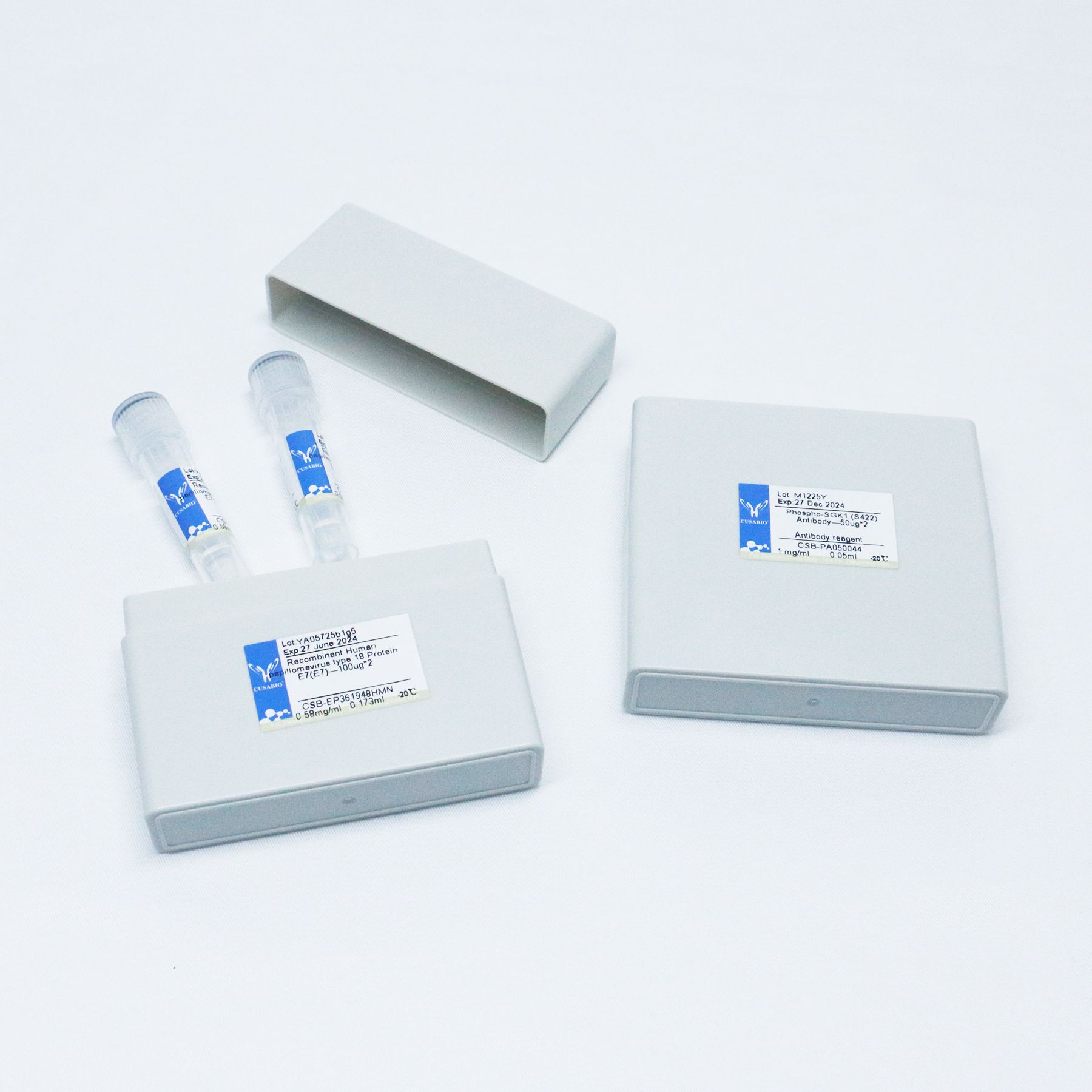
小鼠Bmal1重组蛋白Arnt3;Brain and mus
cle ARNT-like 1Mouse Basic helix-loop-helix ARNT-like protein 1(Bmal1)蛋白- ¥2328
- CUSABIO

- CN
- CSB-EP895734MO
- 2026年05月21日

企业认证
相关产品推荐更多 >

Recombinant-Apium-graveolens-Chlorophyll-a-b-binding-protein-chloroplasticLHC0Chlorophyll a-b binding protein, chloroplastic Alternative name(s): Allergen= Api g 3
¥10822
人TXNRD2重组蛋白Selenoprotein Z;SelZTR-betaThioredoxin reductase TR3Human Thioredoxin reductase 2, mitochondrial(TXNRD2)(U523S)蛋白
¥1344
//重组蛋白Api m 3Apis mellifera Venom acid phosphatase Acph-1蛋白
¥3168
Grem1/Grem1蛋白Recombinant Rat Gremlin-1 (Grem1)重组蛋白Cysteine knot superfamily 1, BMP antagonist 1 Down-regulated in Mos-transformed cells protein Cktsf1b1, Drm蛋白
¥1836
Recombinant-Varicella-zoster-virus-Glycoprotein-KgKGlycoprotein K; gK Alternative name(s): Syncytial protein
¥11620
万千商家帮你免费找货
0 人在求购买到急需产品
相关阅读
源叶生物 十万种现货试剂速发,品质稳、品类全,实验不再等!Takara 秋促来袭,提取+反转录+定量套装仅 1200 元abinScience 体内级抗体 全年锁价 低至 ¥1200阿拉丁 22万+ 科研级产品现货速发,品质严控、科研无忧- 详细信息
- 文献和实验
- 技术资料
- 保存条件:
We recommend to add 5-50% of glycerol (final concentration) and aliquot for long-term storage at -20℃/-80℃.
- 保质期:
Generally, the shelf life of liquid form is 6 months at -20℃/-80℃. The shelf life of lyophilized form is 12 months at -20℃/-80℃.
- 英文名:
Recombinant Mouse Basic helix-loop-helix ARNT-like protein 1 (Bmal1)
- 库存:
200
- 供应商:
武汉华美生物工程有限公司
- 规格:
20μg
英文名称:
Recombinant Mouse Basic helix-loop-helix ARNT-like protein 1 (Bmal1)品名简称:
Recombinant Mouse Bmal1 protein货号:
CSB-EP895734MO规格:
20μg价格:
2328LC-MS/Western Blot:
/SDS-PAGE:
(Tris-Glycine gel) Discontinuous SDS-PAGE (reduced) with 5% enrichment gel and 15% separation gel.纯度:
Greater than 85% as determined by SDS-PAGE.内毒素:
Not test生物活性:
/基因名:
Bmal1Uniprot No.:
Q9WTL8别名:
Arnt3;Brain and muscle ARNT-like 1种属:
Mus musculus (Mouse)蛋白长度:
Full Length来源:
E.coli分子量:
70.6 kDa表达区域:
1-632aa氨基酸序列:
MADQRMDISSTISDFMSPGPTDLLSGSLGTSGVDCNRKRKGSATDYQLDDFAFEESMDTDKDDPHGRLEYAEHQGRIKNAREAHSQIEKRRRDKMNSFIDELASLVPTCNAMSRKLDKLTVLRMAVQHMKTLRGATNPYTEANYKPTFLSDDELKHLILRAADGFLFVVGCDRGKILFVSESVFKILNYSQNDLIGQSLFDYLHPKDIAKVKEQLSSSDTAPRERLIDAKTGLPVKTDITPGPSRLCSGARRSFFCRMKCNRPSVKVEDKDFASTCSKKKDRKSFCTIHSTGYLKSWPPTKMGLDEDNEPDNEGCNLSCLVAIGRLHSHMVPQPANGEIRVKSMEYVSRHAIDGKFVFVDQRATAILAYLPQELLGTSCYEYFHQDDIGHLAECHRQVLQTREKITTNCYKFKIKDGSFITLRSRWFSFMNPWTKEVEYIVSTNTVVLANVLEGGDPTFPQLTAPPHSMDSMLPSGEGGPKRTHPTVPGIPGGTRAGAGKIGRMIAEEIMEIHRIRGSSPSSCGSSPLNITSTPPPDASSPGGKKILNGGTPDIPSTGLLPGQAQETPGYPYSDSSSILGENPHIGIDMIDNDQGSSSPSNDEAAMAVIMSLLEADAGLGGPVDFSDLPWPL蛋白标签:
C-terminal Flag-tagged产品提供形式:
Liquid or Lyophilized powder缓冲液:
If the delivery form is liquid, the default storage buffer is Tris/PBS-based buffer, 5%-50% glycerol. If the delivery form is lyophilized powder, the buffer before lyophilization is Tris/PBS-based buffer, 6% Trehalose, pH 8.0.储存条件:
We recommend that this vial be briefly centrifuged prior to opening to bring the contents to the bottom. Please reconstitute protein in deionized sterile water to a concentration of 0.1-1.0 mg/mL.We recommend to add 5-50% of glycerol (final concentration) and aliquot for long-term storage at -20℃/-80℃. Our default final concentration of glycerol is 50%. Customers could use it as reference.保质期:
The shelf life is related to many factors, storage state, buffer ingredients, storage temperature and the stability of the protein itself. Generally, the shelf life of liquid form is 6 months at -20℃/-80℃. The shelf life of lyophilized form is 12 months at -20℃/-80℃.货期:
13-23 business days注意事项:
Repeated freezing and thawing is not recommended. Store working aliquots at 4℃ for up to one week.功能1:
Transcriptional activator which forms a core component of the circadian clock. The circadian clock, an internal time-keeping system, regulates various physiological processes through the generation of approximately 24 hour circadian rhythms in gene expression, which are translated into rhythms in metabolism and behavior. It is derived from the Latin roots 'circa' (about) and 'diem' (day) and acts as an important regulator of a wide array of physiological functions including metabolism, sleep, body temperature, blood pressure, endocrine, immune, cardiovascular, and renal function. Consists of two major components: the central clock, residing in the suprachiasmatic nucleus (SCN) of the brain, and the peripheral clocks that are present in nearly every tissue and organ system. Both the central and peripheral clocks can be reset by environmental cues, also known as Zeitgebers (German for 'timegivers'). The predominant Zeitgeber for the central clock is light, which is sensed by retina and signals directly to the SCN. The central clock entrains the peripheral clocks through neuronal and hormonal signals, body temperature and feeding-related cues, aligning all clocks with the external light/dark cycle. Circadian rhythms allow an organism to achieve temporal homeostasis with its environment at the molecular level by regulating gene expression to create a peak of protein expression once every 24 hours to control when a particular physiological process is most active with respect to the solar day. Transcription and translation of core clock components (CLOCK, NPAS2, ARNTL/BMAL1, ARNTL2/BMAL2, PER1, PER2, PER3, CRY1 and CRY2) plays a critical role in rhythm generation, whereas delays imposed by post-translational modifications (PTMs) are important for determining the period (tau) of the rhythms (tau refers to the period of a rhythm and is the length, in time, of one complete cycle). A diurnal rhythm is synchronized with the day/night cycle, while the ultradian and infradian rhythms have a period shorter and longer than 24 hours, respectively. Disruptions in the circadian rhythms contribute to the pathology of cardiovascular diseases, cancer, metabolic syndromes and aging. A transcription/translation feedback loop (TTFL) forms the core of the molecular circadian clock mechanism. Transcription factors, CLOCK or NPAS2 and ARNTL/BMAL1 or ARNTL2/BMAL2, form the positive limb of the feedback loop, act in the form of a heterodimer and activate the transcription of core clock genes and clock-controlled genes (involved in key metabolic processes), harboring E-box elements (5'-CACGTG-3') within their promoters. The core clock genes: PER1/2/3 and CRY1/2 which are transcriptional repressors form the negative limb of the feedback loop and interact with the CLOCK|NPAS2-ARNTL/BMAL1|ARNTL2/BMAL2 heterodimer inhibiting its activity and thereby negatively regulating their own expression. This heterodimer also activates nuclear receptors NR1D1/2 and RORA/B/G, which form a second feedback loop and which activate and repress ARNTL/BMAL1 transcription, respectively. ARNTL/BMAL1 positively regulates myogenesis and negatively regulates adipogenesis via the transcriptional control of the genes of the canonical Wnt signaling pathway. Plays a role in normal pancreatic beta-cell function; regulates glucose-stimulated insulin secretion via the regulation of antioxidant genes NFE2L2/NRF2 and its targets SESN2, PRDX3, CCLC and CCLM. Negatively regulates the mTORC1 signaling pathway; regulates the expression of MTOR and DEPTOR. Controls diurnal oscillations of Ly6C inflammatory monocytes; rhythmic recruitment of the PRC2 complex imparts diurnal variation to chemokine expression that is necessary to sustain Ly6C monocyte rhythms. Regulates the expression of HSD3B2, STAR, PTGS2, CYP11A1, CYP19A1 and LHCGR in the ovary and also the genes involved in hair growth. Plays an important role in adult hippocampal neurogenesis by regulating the timely entry of neural stem/progenitor cells (NSPCs) into the cell cycle and the number of cell divisions that take place prior to cell-cycle exit. Regulates the circadian expression of CIART and KLF11. The CLOCK-ARNTL/BMAL1 heterodimer regulates the circadian expression of SERPINE1/PAI1, VWF, B3, CCRN4L/NOC, NAMPT, DBP, MYOD1, PPARGC1A, PPARGC1B, SIRT1, GYS2, F7, NGFR, GNRHR, BHLHE40/DEC1, ATF4, MTA1, KLF10 and also genes implicated in glucose and lipid metabolism. Promotes rhythmic chromatin opening, regulating the DNA accessibility of other transcription factors. May play a role in spermatogenesis; contributes to the chromatoid body assembly and physiology. The NPAS2-ARNTL/BMAL1 heterodimer positively regulates the expression of MAOA, F7 and LDHA and modulates the circadian rhythm of daytime contrast sensitivity by regulating the rhythmic expression of adenylate cyclase type 1 (ADCY1) in the retina. The preferred binding motif for the CLOCK-ARNTL/BMAL1 heterodimer is 5'-CACGTGA-3', which contains a flanking Ala residue in addition to the canonical 6-nucleotide E-box sequence. CLOCK specifically binds to the half-site 5'-CAC-3', while ARNTL binds to the half-site 5'-GTGA-3'. The CLOCK-ARNTL/BMAL1 heterodimer also recognizes the non-canonical E-box motifs 5'-AACGTGA-3' and 5'-CATGTGA-3'. Essential for the rhythmic interaction of CLOCK with ASS1 and plays a critical role in positively regulating CLOCK-mediated acetylation of ASS1. Plays a role in protecting against lethal sepsis by limiting the expression of immune checkpoint protein CD274 in macrophages in a PKM2-dependent manner. Regulates the diurnal rhythms of skeletal muscle metabolism via transcriptional activation of genes promoting triglyceride synthesis (DGAT2) and metabolic efficiency (COQ10B).功能2:
/文献:
/研究领域:
Cardiovascular请点击“在线询价”找客服索取产品说明书及引用文献目录,产品实时更新参数、价格信息、更多文献信息可以查看cusabio官网
风险提示:丁香通仅作为第三方平台,为商家信息发布提供平台空间。用户咨询产品时请注意保护个人信息及财产安全,合理判断,谨慎选购商品,商家和用户对交易行为负责。对于医疗器械类产品,请先查证核实企业经营资质和医疗器械产品注册证情况。
 文献和实验
文献和实验Quantal Analysis of Endplate Potentials in Mouse Flexor Digitorum Brevis Muscle
Angaut‐Petit, D., Molgo, J., Connold, A.L., and Faille, L. 1987. The levator auris longus muscle of the mouse: A convenient preparation for studies of short‐ and long‐term presynaptic effects of drugs
Basic Protocol 3: Physiological Recording of Motor Units in the EDL Muscle of the Mouse Commentary Literature Cited Figures Tables
describes vital staining of neuromuscular junctions in the mouse triangularis sterni muscle in one incubation step, combining presynaptic, motor nerve terminal staining with the styryl dye FM1?43, which labels recycling synaptic vesicles, and TRITC
 技术资料
技术资料暂无技术资料 索取技术资料

