

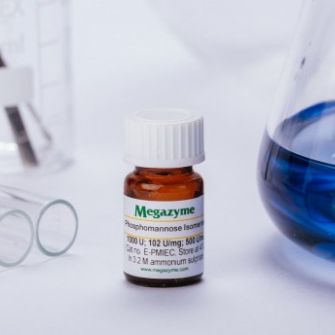
- ¥3446
- Megazyme
- 爱尔兰
- E-PMIEC
- 2026年08月12日

企业认证
相关产品推荐更多 >

万千商家帮你免费找货
0 人在求购买到急需产品
相关阅读
AJE 润色服务限时 8 折起,权威机构信任 15+ 年Cytoscape 教程来了!快速实现顶刊同款通路网络图五大应用案例:Mustang Q 膜层析应用全解析1 个小工具,一次性搞定流程图、质粒图谱和信号通路图- 详细信息
- 文献和实验
- 技术资料
- 保质期:
3年
- 英文名:
Phosphomannose isomerase (E. coli)
- 库存:
请咨询
- 供应商:
上海经科化学科技有限公司
- CAS号:
9023-88-5
- 保存条件:
2-8℃
- 规格:
1000U

High purity recombinant Phosphomannose isomerase (Escherichia coli) for use in research, biochemical enzyme assays and in vitro diagnostic analysis.
| Content: | 1,000 Units |
| Shipping Temperature: | Ambient |
| Storage Temperature: | 2-8oC |
| Formulation: | In 3.2 M ammonium sulphate |
| Physical Form: | Suspension |
| Stability: | > 1 year under recommended storage conditions |
| Enzyme Activity: | Isomerase |
| EC Number: | 5.3.1.8 |
| CAS Number: | 9023-88-5 |
| Synonyms: | mannose-6-phosphate isomerase; D-mannose-6-phosphate aldose-ketose-isomerase |
| Source: | Escherichia coli |
| Molecular Weight: | 43,915 |
| Concentration: | Supplied at ~ 500 U/mL |
| Expression: | Recombinant from Escherichia coli |
| Specificity: | Catalyses the reaction: D-Mannose 6-phosphate = D-fructose 6-phosphate |
| Specific Activity: | ~ 100 U/mg (25oC, pH 7.6 on mannose 6-phosphate) |
| Unit Definition: | One Unit of phosphomannose isomerase activity is defined as the amount of enzyme required to release one µmole of fructose 6-phosphate from mannose 6-phosphate (3.14 mM) per minute in the presence of NAD+ at pH 7.6 and 25oC. |
| Temperature Optima: | 40oC |
| pH Optima: | 7.6 |
| Application examples: | Applications for the measurement of D-mannose in carbohydrate research and in the food and feeds, fermentation, wine, beverage and dairy industries. |
如需磷酸甘露糖异构酶[大肠杆菌]产品完整说明书,
请向上海经科客服索取!

风险提示:丁香通仅作为第三方平台,为商家信息发布提供平台空间。用户咨询产品时请注意保护个人信息及财产安全,合理判断,谨慎选购商品,商家和用户对交易行为负责。对于医疗器械类产品,请先查证核实企业经营资质和医疗器械产品注册证情况。
 文献和实验
文献和实验1.Enterococcus faecalis α1-2‐mannosidase (EfMan‐I): an efficient catalyst for glycoprotein N‐glycan modification.
Li, Y., Li, R., Yu, H., Sheng, X., Wang, J., Fisher, A. J. & Chen, X. (2020). FEBS Letters, 594(3), 439-451.
磷酸己糖异构酶 phosphohexose isomerase
亦称为己糖磷酸异构酶。已知的有磷酸葡糖异构酶(phosphoglucose isomerase)和磷酸甘露糖异构酶( phosphomannose isomerase)。
刀”)。 一、限制酶概念提出的背景 20世纪30年代,微生物学家发现,微生物的噬菌体不能交叉感染,如E coli K株的噬菌体只能感染E coli K株,不能感染其他株,反之亦然。这种现象称为“限制现象”。 1962年,W.Arber提出一个假设来解释上述现象。他认为这是细菌中有2种以上功能不同的酶,一种是核酸内切酶,能识别并切断外来DNA分子的某些部位,使外来DNA失去活性,限制外来噬菌体的繁殖,把这类酶称为限制性核酸内切酶。 能识别并切断外来DNA分子的某些部位,使外来DNA失去活性,限制外来噬菌
的稳定性 mRNA的快速降解势必影响蛋白质的产生。因此在这一部分重点阐述决定mRNA稳定性的因素,这将在E.coli高效表达外源基因中有实际应用。在E.coli中有多种不同的RNase参与mRNA的降解,其中包括内切核酸酶(RNase E,RNase K和RNase III)和3’外切核酸酶(RNase II和多聚核苷酸磷酸化酶[PNPase]),目前尚未在原核细胞中发现5’外切核酸酶[110]。mRNA的降解并非由非特异性的外切核酸酶随机剪切而引起,因为在mRNA的长度和半衰期之间并没有反向
 技术资料
技术资料需要更多技术资料 索取更多技术资料

