

- 询价
- VivaCell

- C3570-0500
- 2026年04月07日

企业认证
相关产品推荐更多 >

万千商家帮你免费找货
0 人在求购买到急需产品
- 详细信息
- 文献和实验
- 技术资料
- 供应商:
上海逍鹏生物科技有限公司
- 库存:
充足
- 英文名:
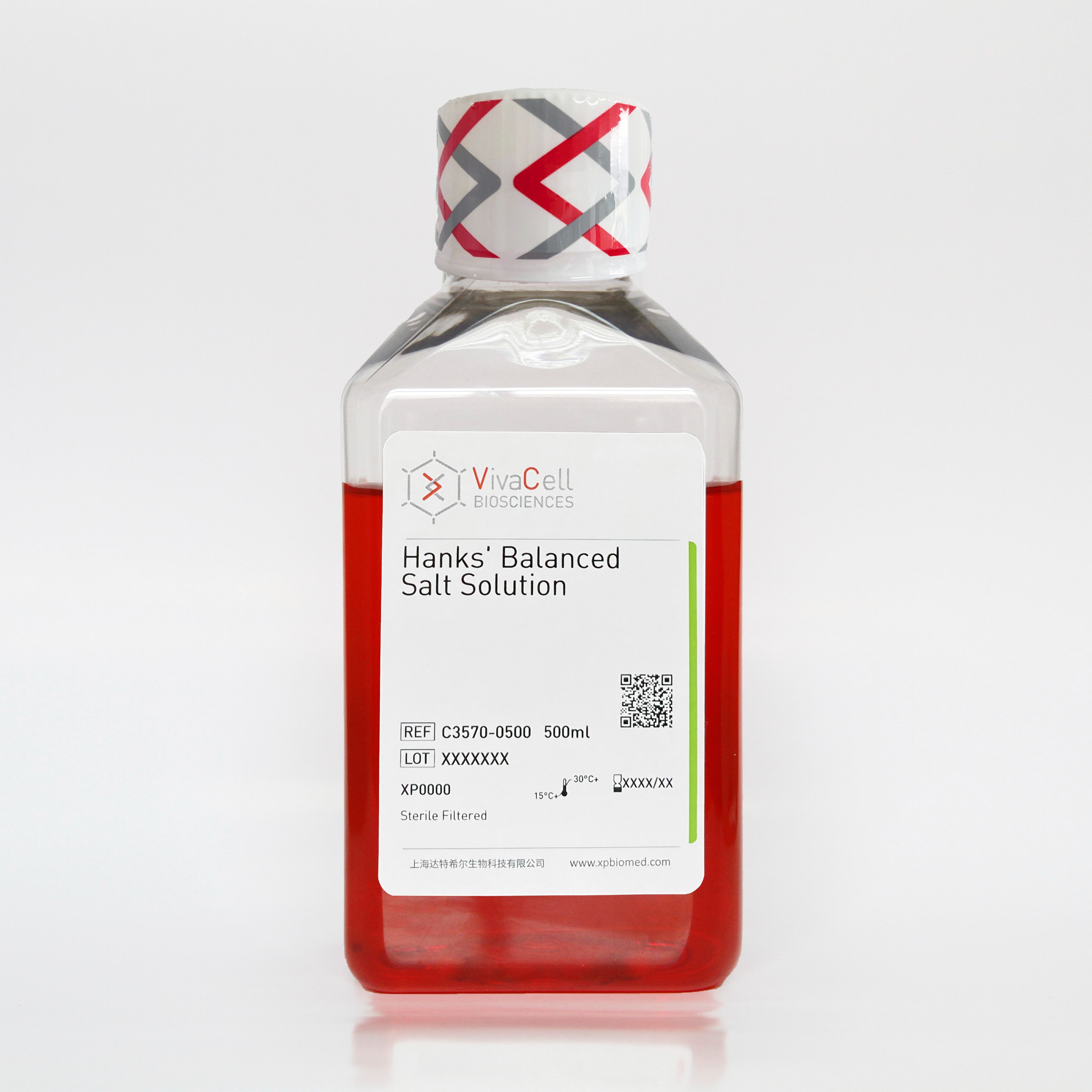
Hanks’Balanced Salt Solution
- 规格:
500ml
All media used in tissue culture have a basis of a synthetic mixture of inorganic salts known as a physiological or balanced salt solution (BSS). All the physiological salt solutions have been derived from the salt solution originally described by Sydney Ringer (1885). The first balanced salt solution to be developed specifically for supporting the metabolism of mammalian cells was Tyrode's solution. Since then many modifications have been done to obtain better buffering salt solutions and to prevent calcium precipitation.
The function of a salt solution is: To maintain the medium within physiological pH range. To maintain intracellular and extra cellular osmotic balance. Modified with a carbohydrate, such as glucose serves as an energy source. It is most commonly used for tissue disaggregation and monolayer dispersal since presence of Calcium and Magnesium ions may hinder the trypsin activity. It is also used for routine immunohistochemical testing and as a general purpose solution for washing cells in various haematological and molecular biology procedures.
The product should be stored at room temperature (15-30°C). The product should not be left in the light for prolonged periods as it is light-sensitive. When stored in the dark under ideal conditions, the product is stable until the expiry date.
【Procedure】
1.Take a bottle from the defined storage conditions at Room Temperature (15-30°C) and read the label.
2. Ensure that the cap of the bottle is tight.
3.Gently swirl the solution in the bottle.
4. Wipe the outside of the bottle with a disinfectant solution such as 70% ethanol.
5. Using aseptic/sterile technique under a laminar-flow culture hood, work according to established protocols.
【Quality Control】
Phosphate Buffered Salined is tested for sterility, pH, Osmolality and Endotoxin concentrations.
【Precaution and Disclaimer】
For research use only, not for clinical diagnosis and treatment.
风险提示:丁香通仅作为第三方平台,为商家信息发布提供平台空间。用户咨询产品时请注意保护个人信息及财产安全,合理判断,谨慎选购商品,商家和用户对交易行为负责。对于医疗器械类产品,请先查证核实企业经营资质和医疗器械产品注册证情况。
 文献和实验
文献和实验4 , 47.5 mg/L Na2 HPO4 , 调pH至7.2. HBSS一共分为四种,含钙镁,含酚红;含钙镁,不含酚红;不含钙镁,含酚红(D-Hanks );不含钙镁,不含酚红(D-Hanks)。此四种产品可根据客户需要自己选择。而如果客户无法判断应该选择哪一种,可以选不含钙镁,不含酚红(D-Hanks )。 Hanks’ 含钙镁 含酚红 Hanks’
。 ●再一次在培养基中悬浮细胞,计数和接种细胞,进行培养。 (3)Dispase ●用无菌解剖刀和剪子把剩余组织切成3~4 mm小片,用不含钙镁的平衡盐溶液清洗组织碎片几次。 ●加入Dispase(0.6~2.4单位/ml 溶解在无钙镁的平衡盐溶液) ●在37℃孵育20分钟到几个小时。 ●通过无菌不锈钢丝网或尼龙网过滤细胞悬液,以分离分散细胞、组织碎片和较大的碎片。如果需要进一步的解聚,在碎片中加入新鲜的Dispase。 ●通过离心在平衡盐溶液中清洗悬液几次。 ●再一
培养液。3. 培养液出现沉淀,同时pH 发生变化: 细菌或真菌污染。 丢弃培养物或用抗生素除菌。4. 培养细胞不贴壁: 胰蛋白酶消化过度;支原体污染;培养液中无贴壁因子。 缩短胰蛋白酶消化时间或降低胰蛋白酶浓度。 分离培养物,检测支原体。清洁支架和培养箱。如发现支原体污染,丢弃培养物。5. 悬浮细胞成簇: 培养液中含钙、镁离子。支原体污染。蛋白酶过度消化使得细胞裂解释放DNA。 用无钙镁平衡盐溶液洗涤细胞,轻轻吹吸细胞获得单细胞悬液。 分离培养物,检测支原体。如发现
 技术资料
技术资料暂无技术资料 索取技术资料

